

Page 37: of Offshore Engineer Magazine (Nov/Dec 2025)
Read this page in Pdf, Flash or Html5 edition of Nov/Dec 2025 Offshore Engineer Magazine
 36
36
 38
38
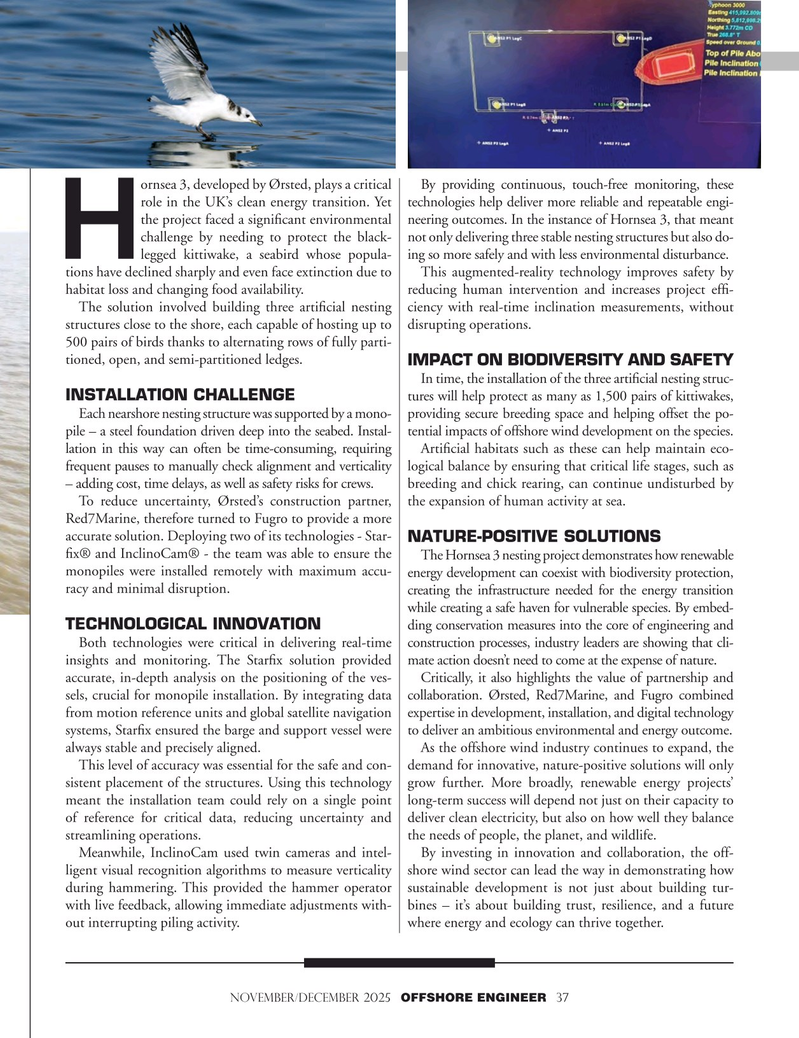
ornsea 3, developed by Ørsted, plays a critical By providing continuous, touch-free monitoring, these role in the UK’s clean energy transition. Yet technologies help deliver more reliable and repeatable engi- the project faced a signifcant environmental neering outcomes. In the instance of Hornsea 3, that meant challenge by needing to protect the black- not only delivering three stable nesting structures but also do-
H legged kittiwake, a seabird whose popula- ing so more safely and with less environmental disturbance. tions have declined sharply and even face extinction due to This augmented-reality technology improves safety by habitat loss and changing food availability. reducing human intervention and increases project eff-
The solution involved building three artifcial nesting ciency with real-time inclination measurements, without structures close to the shore, each capable of hosting up to disrupting operations. 500 pairs of birds thanks to alternating rows of fully parti- tioned, open, and semi-partitioned ledges.
IMPACT ON BIODIVERSITY AND SAFETY
In time, the installation of the three artifcial nesting struc-
INSTALLATION CHALLENGE tures will help protect as many as 1,500 pairs of kittiwakes,
Each nearshore nesting structure was supported by a mono- providing secure breeding space and helping offset the po- pile – a steel foundation driven deep into the seabed. Instal- tential impacts of offshore wind development on the species.
lation in this way can often be time-consuming, requiring Artifcial habitats such as these can help maintain eco- frequent pauses to manually check alignment and verticality logical balance by ensuring that critical life stages, such as – adding cost, time delays, as well as safety risks for crews. breeding and chick rearing, can continue undisturbed by
To reduce uncertainty, Ørsted’s construction partner, the expansion of human activity at sea.
Red7Marine, therefore turned to Fugro to provide a more accurate solution. Deploying two of its technologies - Star-
NATURE-POSITIVE SOLUTIONS fx® and InclinoCam® - the team was able to ensure the
The Hornsea 3 nesting project demonstrates how renewable monopiles were installed remotely with maximum accu- energy development can coexist with biodiversity protection, racy and minimal disruption.
creating the infrastructure needed for the energy transition while creating a safe haven for vulnerable species. By embed- ding conservation measures into the core of engineering and
TECHNOLOGICAL INNOVATION
Both technologies were critical in delivering real-time construction processes, industry leaders are showing that cli- insights and monitoring. The Starfx solution provided mate action doesn’t need to come at the expense of nature.
accurate, in-depth analysis on the positioning of the ves- Critically, it also highlights the value of partnership and sels, crucial for monopile installation. By integrating data collaboration. Ørsted, Red7Marine, and Fugro combined from motion reference units and global satellite navigation expertise in development, installation, and digital technology systems, Starfx ensured the barge and support vessel were to deliver an ambitious environmental and energy outcome.
always stable and precisely aligned. As the offshore wind industry continues to expand, the
This level of accuracy was essential for the safe and con- demand for innovative, nature-positive solutions will only sistent placement of the structures. Using this technology grow further. More broadly, renewable energy projects’ meant the installation team could rely on a single point long-term success will depend not just on their capacity to of reference for critical data, reducing uncertainty and deliver clean electricity, but also on how well they balance streamlining operations. the needs of people, the planet, and wildlife.
Meanwhile, InclinoCam used twin cameras and intel- By investing in innovation and collaboration, the off- ligent visual recognition algorithms to measure verticality shore wind sector can lead the way in demonstrating how during hammering. This provided the hammer operator sustainable development is not just about building tur- with live feedback, allowing immediate adjustments with- bines – it’s about building trust, resilience, and a future out interrupting piling activity. where energy and ecology can thrive together.
NOVEMBER/DECEMBER 2025 OFFSHORE ENGINEER 37