

Page 39: of Offshore Engineer Magazine (Nov/Dec 2025)
Read this page in Pdf, Flash or Html5 edition of Nov/Dec 2025 Offshore Engineer Magazine
 38
38
 40
40
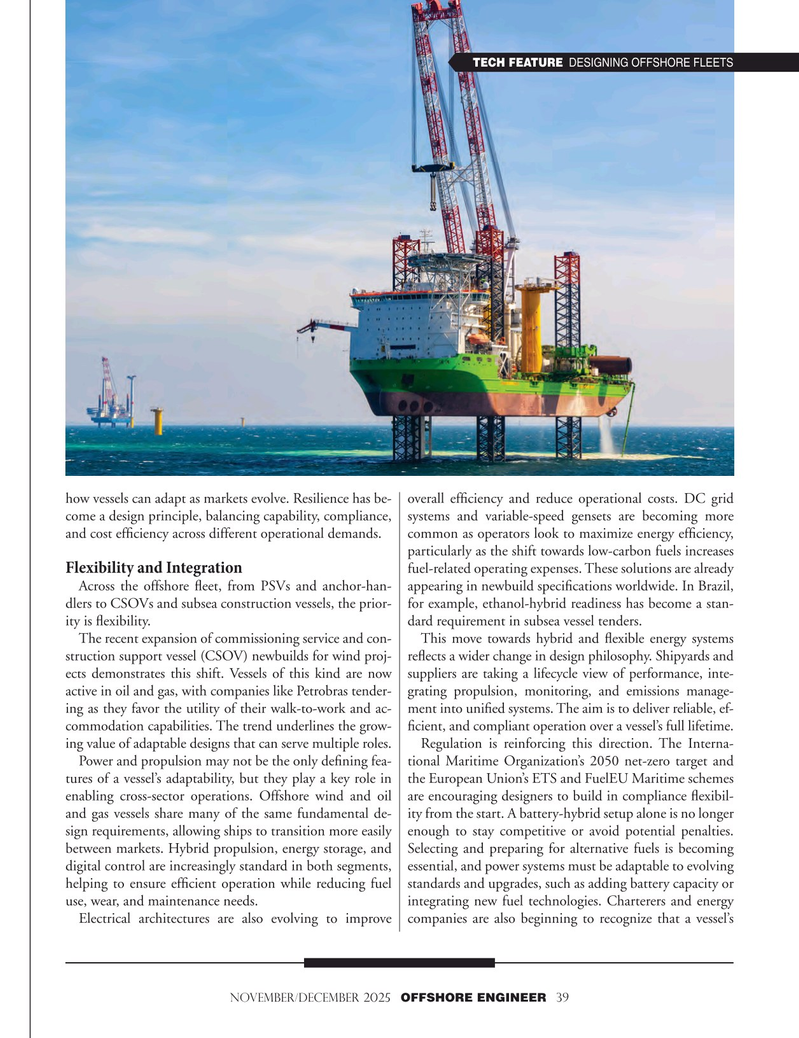
TECH FEATURE DESIGNING OFFSHORE FLEETS how vessels can adapt as markets evolve. Resilience has be- overall effciency and reduce operational costs. DC grid come a design principle, balancing capability, compliance, systems and variable-speed gensets are becoming more and cost effciency across different operational demands. common as operators look to maximize energy effciency, particularly as the shift towards low-carbon fuels increases fuel-related operating expenses. These solutions are already
Flexibility and Integration
Across the offshore feet, from PSVs and anchor-han- appearing in newbuild specifcations worldwide. In Brazil, dlers to CSOVs and subsea construction vessels, the prior- for example, ethanol-hybrid readiness has become a stan- ity is fexibility. dard requirement in subsea vessel tenders.
The recent expansion of commissioning service and con- This move towards hybrid and fexible energy systems struction support vessel (CSOV) newbuilds for wind proj- refects a wider change in design philosophy. Shipyards and ects demonstrates this shift. Vessels of this kind are now suppliers are taking a lifecycle view of performance, inte- active in oil and gas, with companies like Petrobras tender- grating propulsion, monitoring, and emissions manage- ing as they favor the utility of their walk-to-work and ac- ment into unifed systems. The aim is to deliver reliable, ef- commodation capabilities. The trend underlines the grow- fcient, and compliant operation over a vessel’s full lifetime.
ing value of adaptable designs that can serve multiple roles. Regulation is reinforcing this direction. The Interna-
Power and propulsion may not be the only defning fea- tional Maritime Organization’s 2050 net-zero target and tures of a vessel’s adaptability, but they play a key role in the European Union’s ETS and FuelEU Maritime schemes enabling cross-sector operations. Offshore wind and oil are encouraging designers to build in compliance fexibil- and gas vessels share many of the same fundamental de- ity from the start. A battery-hybrid setup alone is no longer sign requirements, allowing ships to transition more easily enough to stay competitive or avoid potential penalties. between markets. Hybrid propulsion, energy storage, and Selecting and preparing for alternative fuels is becoming digital control are increasingly standard in both segments, essential, and power systems must be adaptable to evolving helping to ensure effcient operation while reducing fuel standards and upgrades, such as adding battery capacity or use, wear, and maintenance needs. integrating new fuel technologies. Charterers and energy
Electrical architectures are also evolving to improve companies are also beginning to recognize that a vessel’s
NOVEMBER/DECEMBER 2025 OFFSHORE ENGINEER 39