

Page 21: of Offshore Engineer Magazine (Jan/Feb 2026)
Read this page in Pdf, Flash or Html5 edition of Jan/Feb 2026 Offshore Engineer Magazine
 20
20
 22
22
MARKETS RIGS nlike larger jackup regions where scale provides greater fexibility, relatively minor changes in supply can have an outsized impact. The avail-
U ability, reactivation, or retirement of a single rig can materially shift utilisation levels, dayrate negotiations, and contracting dynamics, often with limited visibility.
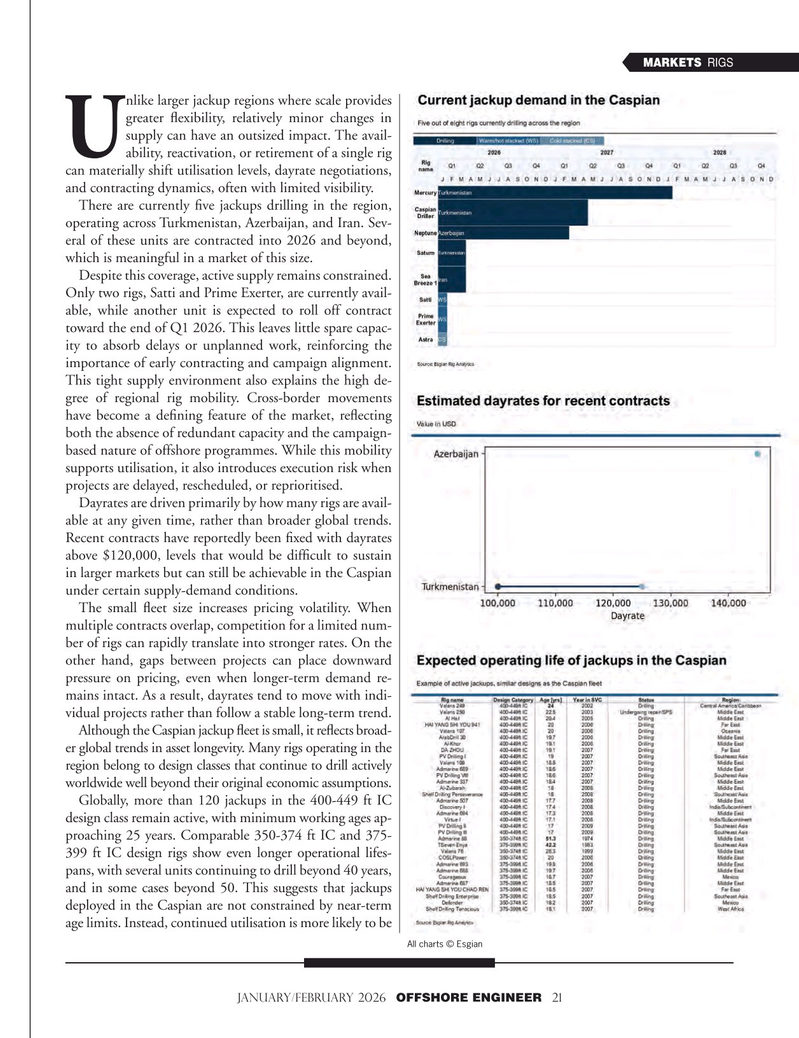
There are currently fve jackups drilling in the region, operating across Turkmenistan, Azerbaijan, and Iran. Sev- eral of these units are contracted into 2026 and beyond, which is meaningful in a market of this size.
Despite this coverage, active supply remains constrained.
Only two rigs, Satti and Prime Exerter, are currently avail- able, while another unit is expected to roll off contract toward the end of Q1 2026. This leaves little spare capac- ity to absorb delays or unplanned work, reinforcing the importance of early contracting and campaign alignment.
This tight supply environment also explains the high de- gree of regional rig mobility. Cross-border movements have become a defning feature of the market, refecting both the absence of redundant capacity and the campaign- based nature of offshore programmes. While this mobility supports utilisation, it also introduces execution risk when projects are delayed, rescheduled, or reprioritised.
Dayrates are driven primarily by how many rigs are avail- able at any given time, rather than broader global trends.
Recent contracts have reportedly been fxed with dayrates above $120,000, levels that would be diffcult to sustain in larger markets but can still be achievable in the Caspian under certain supply-demand conditions.
The small feet size increases pricing volatility. When multiple contracts overlap, competition for a limited num- ber of rigs can rapidly translate into stronger rates. On the other hand, gaps between projects can place downward pressure on pricing, even when longer-term demand re- mains intact. As a result, dayrates tend to move with indi- vidual projects rather than follow a stable long-term trend.
Although the Caspian jackup feet is small, it refects broad- er global trends in asset longevity. Many rigs operating in the region belong to design classes that continue to drill actively worldwide well beyond their original economic assumptions.
Globally, more than 120 jackups in the 400-449 ft IC design class remain active, with minimum working ages ap- proaching 25 years. Comparable 350-374 ft IC and 375- 399 ft IC design rigs show even longer operational lifes- pans, with several units continuing to drill beyond 40 years, and in some cases beyond 50. This suggests that jackups deployed in the Caspian are not constrained by near-term age limits. Instead, continued utilisation is more likely to be
All charts © Esgian
JANUARY/FEBRUARY 2026 OFFSHORE ENGINEER 21