

Page 34: of Offshore Engineer Magazine (Jan/Feb 2026)
Read this page in Pdf, Flash or Html5 edition of Jan/Feb 2026 Offshore Engineer Magazine
 33
33

 35
35
FPSOs ALTERNATIVE ENERGY
A new design from SBM
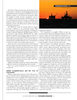
Offshore of a floating production storage and offloading (FPSO) unit focused on the production of blue ammonia has earned approval in principle from ABS.
Image courtesy SBM
FPSOs & MARITIME’S
ENERGY TRANSITION
By Philip Lewis, Research Director, Intelatus Global Partners ast year, the International Energy Agency (IEA)
IS THERE DEMAND FOR LOW- AND forecast that, under current national policies,
ZERO-EMISSION FUELS?
shipping’s global emissions will rise from ~847
Demand for cost-competitive low and zero emission fu- million tonnes of CO2 in 2024 to ~1,060 mil- els is growing in the maritime sector.
Llion tonnes of CO2 by 2050. This is far from the
According to DNV Veracity, ~2,330 alternative fuel ves-
IMO’s target net zero GHG on a full lifecycle well-to-wake sels are in operation or on order. Close to 65% of the ves- basis by/around 2050.
sels can run on LNG, ~19% methanol, ~13% LPG and
The IEA’s report was published in the context of a chang- ~2% each for hydrogen and ammonia. Most of the alter- ing relationship within the energy trilemma, where energy native fuel vessels feature dual fuel engines that continue affordability and security are prioritized over the energy to run on conventional carbon-based marine fuels. Cost transition. In shipping terms, the framework to deliver net competitive low and zero carbon supply is needed.
zero adopted (without the USA and objections from some
Member States) within the IMOs Marine Environment
THE COLOR OF FUEL
Protection Committee (MEPC) were not adopted in Octo-
Using methanol as an example, there are many pathways ber’s IMO meeting as a result of, among others, signifcant to produce methanol, from non-renewable to renewable pressure from the USA and Saudi Arabia. The adoption dis- sources, resulting in low- to high- carbon intensity fuel. cussion has been delayed for one year until October 2026.
For low and zero emission fuels, we look to blue, green
While a signifcant setback to the net zero framework, and pink (from nuclear power) methanol, ammonia and energy transition in shipping continues and the search for hydrogen. Blue fuels generally require natural gas to pro- low and zero emission fuels maintains momentum. In- duce the hydrogen, that is the base of alternative methanol creasing interest in FPSOs to be part of the low and zero and ammonia. In the context of low and zero well-to-wake emission supply solution has increased.
maritime fuels, the question of certifcation is still being 34 OFFSHORE ENGINEER OEDIGITAL.COM