
Page 48: of Marine Technology Magazine (Nov/Dec 2014)
Fresh Water Monitoring & Senors
Read this page in Pdf, Flash or Html5 edition of Nov/Dec 2014 Marine Technology Magazine
 47
47
 49
49
These rapid changes are very easy to 2012. Nitrate sensors on small streams The following information was extract- miss with traditional water-quality mon- and large rivers throughout the Missis- ed directly from the U.S. Geological itoring approaches. sippi River basin are improving our abil- Survey (USGS) report. For full details
However, hourly information on nitrate ity track where the pulses are coming and references, please visit: levels improves the accuracy and reduc- from and forecast when they will arrive http://ca.water.usgs.gov/pubs/ es the uncertainty in estimating nitrate at the Gulf. 2014/PellerinEtAl2014.pdf loads to the Gulf of Mexico, especially The USGS, in cooperation with nu- during drought and ? ood years. merous local, state, and other federal Abstract –
This high frequency data also provides agencies, currently operates over 100 Accurately quantifying nitrate (NO ) 3 new insights into timing and magnitude real-time nitrate sensors across the Na- loading from the Mississippi River is of nitrate ? ushing from soils during wet tion. important for predicting summer hy- and dry conditions. Real-time nitrate monitoring is sup- poxia in the Gulf of Mexico and target-
For instance, the high frequency data ported by the USGS National Stream ing nutrient reduction within the basin. revealed high nitrate concentrations dur- Quality Accounting Network, Coopera- Loads have historically been modeled ing the spring and early summer of both tive Water Program, and the National with regression-based techniques, but 2013 and 2014 following the drought of Water-Quality Assessment Program. recent advances with high frequency
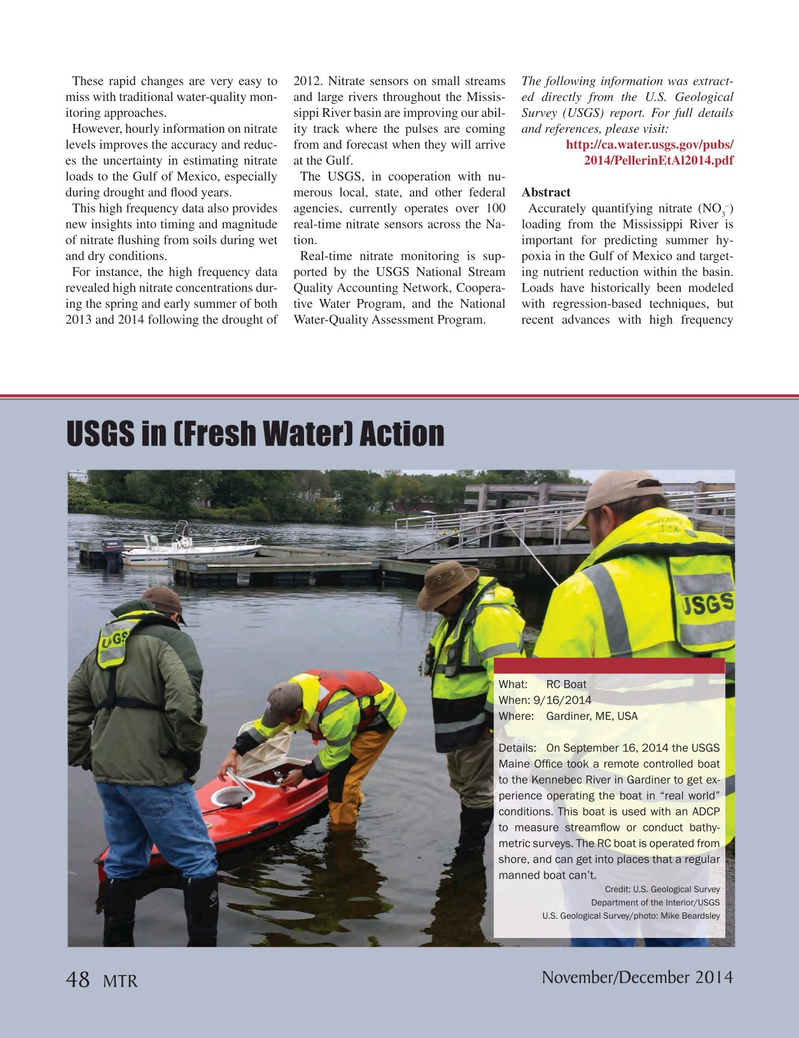
USGS in (Fresh Water) Action
What: RC Boat
When: 9/16/2014
Where: Gardiner, ME, USA
Details: On September 16, 2014 the USGS
Maine Of? ce took a remote controlled boat to the Kennebec River in Gardiner to get ex- perience operating the boat in “real world” conditions. This boat is used with an ADCP to measure stream? ow or conduct bathy- metric surveys. The RC boat is operated from shore, and can get into places that a regular manned boat can’t.
Credit: U.S. Geological Survey
Department of the Interior/USGS
U.S. Geological Survey/photo: Mike Beardsley
November/December 2014 48
MTR
MTR #9 (34-49).indd 48 MTR #9 (34-49).indd 48 12/9/2014 10:59:49 AM12/9/2014 10:59:49 AM