
Page 18: of Marine Technology Magazine (Jun/Jul 2015)
Hydrographic Survey
Read this page in Pdf, Flash or Html5 edition of Jun/Jul 2015 Marine Technology Magazine
 17
17
 19
19
Wireless Intervention highly valuable information that would not be detected dur-
Extended Reservoir Monitoring
Via the application of wireless, well testing no longer has ing the course of a typical 48-hour or 72-hour pressure build- to end at well abandonment. Advanced reservoir testing now up performed during a drill stem test (DST). In either case, enables abandoned wells, zones or pilot holes to be monitored high-value reservoir data is being collected over long moni- for extended periods beyond ? nal well abandonment. toring periods and at low incremental well cost. In Cableless
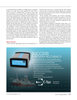
Post-abandonment reservoir pressure data is being used by Telemetry Technology, or CaTS, that pressure data is trans- operators to monitor for connectivity with adjacent assets that mitted wirelessly using a digital signal that provides reassur- are either being produced or injected into, and to collect long ance no loss of ? delity will occur in the transmission’s data. term pressure buildup data to investigate far reservoir bound- Each gauge has its own address, so multiple discrete (well/ aries and establish connected volumes. This is proving to be reservoir) zones can be monitored. Twenty zones have been instrumented successfully in a single well comprising stacked reservoir sands. The pressure/temperature data transmitted from downhole is stored at the seabed in a battery powered subsea receiver rated for water depths of 10,000 feet. The data is the collected from the receiver by a supply vessel passing overhead the abandoned well location and uploading the data from the receiver using wireless through-seawater communi- cations. Once installed in an abandoned subsea well, there is no requirement to reenter the well using a semi-sub rig. The only remaining abandonment liability is to sever and recover the wellhead at a convenient time in the future, typically by workboat.
Better Well Safety
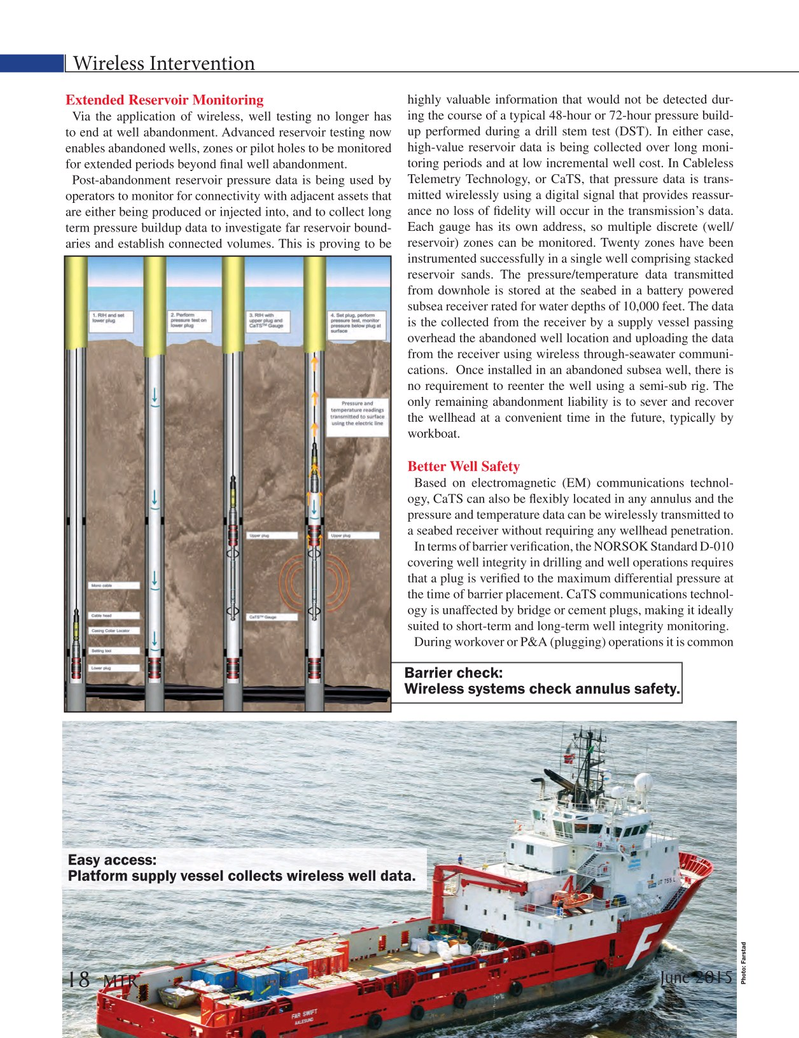
Based on electromagnetic (EM) communications technol- ogy, CaTS can also be ? exibly located in any annulus and the pressure and temperature data can be wirelessly transmitted to a seabed receiver without requiring any wellhead penetration.
In terms of barrier veri? cation, the NORSOK Standard D-010 covering well integrity in drilling and well operations requires that a plug is veri? ed to the maximum differential pressure at the time of barrier placement. CaTS communications technol- ogy is unaffected by bridge or cement plugs, making it ideally suited to short-term and long-term well integrity monitoring.
During workover or P&A (plugging) operations it is common
Barrier check:
Wireless systems check annulus safety.
Easy access:
Platform supply vessel collects wireless well data.
June 2015
Photo: Farstad 18 MTR
MTR #5 (18-33).indd 18 MTR #5 (18-33).indd 18 6/11/2015 9:52:45 AM6/11/2015 9:52:45 AM