Page 17: of Marine Technology Magazine (Jun/Jul 2016)
Hydrographic Survey
Read this page in Pdf, Flash or Html5 edition of Jun/Jul 2016 Marine Technology Magazine
 16
16
 18
18
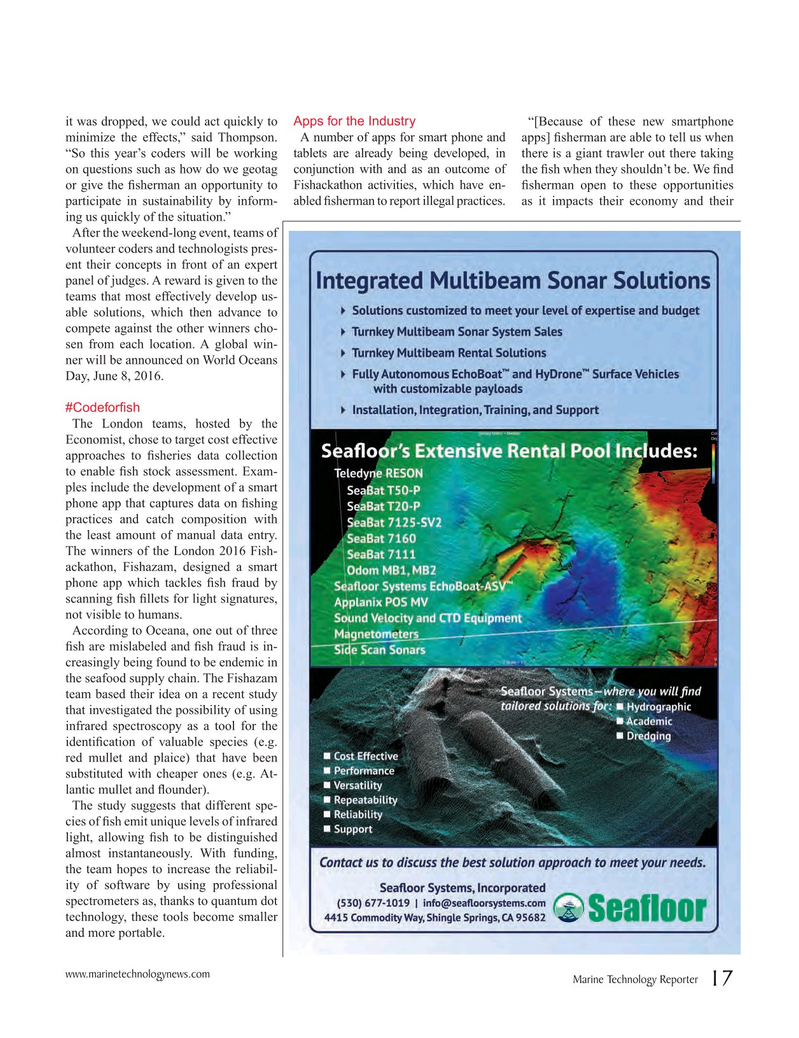
it was dropped, we could act quickly to Apps for the Industry “[Because of these new smartphone minimize the effects,” said Thompson. A number of apps for smart phone and apps] ? sherman are able to tell us when “So this year’s coders will be working tablets are already being developed, in there is a giant trawler out there taking on questions such as how do we geotag conjunction with and as an outcome of the ? sh when they shouldn’t be. We ? nd or give the ? sherman an opportunity to Fishackathon activities, which have en- ? sherman open to these opportunities participate in sustainability by inform- abled ? sherman to report illegal practices. as it impacts their economy and their ing us quickly of the situation.”
After the weekend-long event, teams of volunteer coders and technologists pres- ent their concepts in front of an expert panel of judges. A reward is given to the teams that most effectively develop us- able solutions, which then advance to compete against the other winners cho- sen from each location. A global win- ner will be announced on World Oceans
Day, June 8, 2016.
#Codefor? sh
The London teams, hosted by the
Economist, chose to target cost effective approaches to ? sheries data collection to enable ? sh stock assessment. Exam- ples include the development of a smart phone app that captures data on ? shing practices and catch composition with the least amount of manual data entry.
The winners of the London 2016 Fish- ackathon, Fishazam, designed a smart phone app which tackles ? sh fraud by scanning ? sh ? llets for light signatures, not visible to humans.
According to Oceana, one out of three ? sh are mislabeled and ? sh fraud is in- creasingly being found to be endemic in the seafood supply chain. The Fishazam team based their idea on a recent study that investigated the possibility of using infrared spectroscopy as a tool for the identi? cation of valuable species (e.g. red mullet and plaice) that have been substituted with cheaper ones (e.g. At- lantic mullet and ? ounder).
The study suggests that different spe- cies of ? sh emit unique levels of infrared light, allowing ? sh to be distinguished almost instantaneously. With funding, the team hopes to increase the reliabil- ity of software by using professional spectrometers as, thanks to quantum dot technology, these tools become smaller and more portable.
www.marinetechnologynews.com
Marine Technology Reporter 17
MTR #5 (1-17).indd 17 6/2/2016 10:53:48 AM