Page 15: of Marine Technology Magazine (Sep/Oct 2017)
Ocean Observation: Gliders, Buoys & Sub-Surface Networks
Read this page in Pdf, Flash or Html5 edition of Sep/Oct 2017 Marine Technology Magazine
 14
14
 16
16
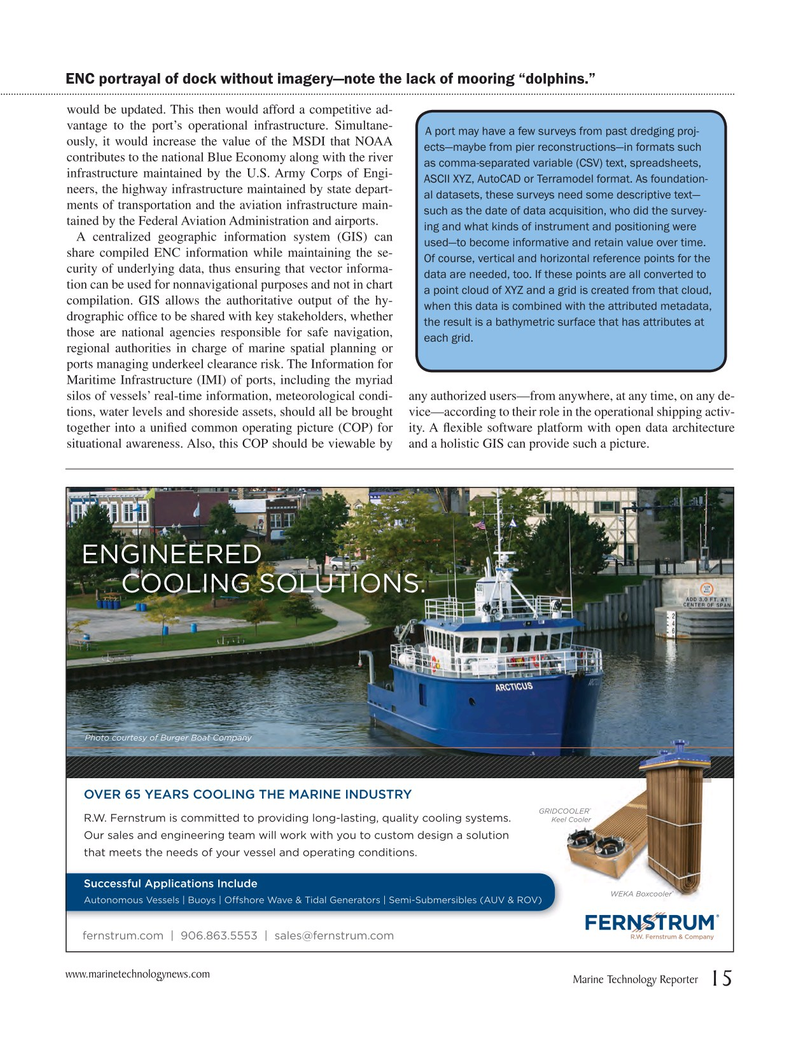
ENC portrayal of dock without imagery—note the lack of mooring “dolphins.” would be updated. This then would afford a competitive ad- vantage to the port’s operational infrastructure. Simultane-
A port may have a few surveys from past dredging proj- ously, it would increase the value of the MSDI that NOAA ects—maybe from pier reconstructions—in formats such contributes to the national Blue Economy along with the river as comma-separated variable (CSV) text, spreadsheets, infrastructure maintained by the U.S. Army Corps of Engi-
ASCII XYZ, AutoCAD or Terramodel format. As foundation- neers, the highway infrastructure maintained by state depart- al datasets, these surveys need some descriptive text— ments of transportation and the aviation infrastructure main- such as the date of data acquisition, who did the survey- tained by the Federal Aviation Administration and airports. ing and what kinds of instrument and positioning were
A centralized geographic information system (GIS) can used—to become informative and retain value over time. share compiled ENC information while maintaining the se-
Of course, vertical and horizontal reference points for the curity of underlying data, thus ensuring that vector informa- data are needed, too. If these points are all converted to tion can be used for nonnavigational purposes and not in chart a point cloud of XYZ and a grid is created from that cloud, compilation. GIS allows the authoritative output of the hy- when this data is combined with the attributed metadata, drographic of