
Page 17: of Marine Technology Magazine (Mar/Apr 2021)
Oceanographic Instrumentation & Sensors
Read this page in Pdf, Flash or Html5 edition of Mar/Apr 2021 Marine Technology Magazine
 16
16
 18
18
utonomous underwater vehicles have become versatile tools for exploring the seas. Purdue
University researchers are studying means to optimize the design, aiming to deliver a highly
A maneuverable, low-cost underwater glider that operates silently, with components and sensors that can be easily swapped out or added according to a wide range of mis- sion speci? cations.
“Our goal is persistent operation of mobile robots in chal- lenging environments,” said Nina Mahmoudian, associate professor of mechanical engineering. “Most underwater ro- bots have limited battery life and must return back after just a few hours. For long-endurance operations, an underwater glider can travel for weeks or months between charges but could bene? t from increased deployment opportunities in high-risk areas.”
An underwater glider differs from other marine robots be- cause it has no propeller or active propulsion system. It chang- es its own buoyancy to sink down and rise up, and to propel itself forward. Although this up-and-down approach enables very energy-ef? cient vehicles, it presents problems: the ve- hicles are slow and not maneuverable, especially in shallow water.
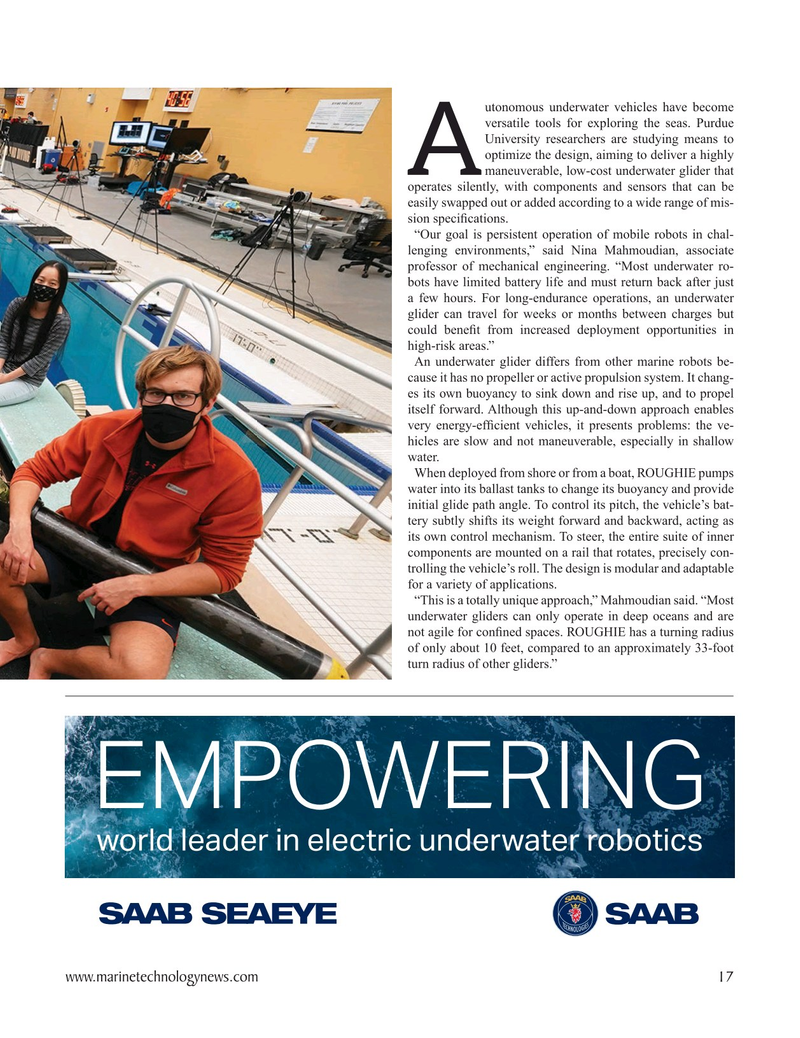
When deployed from shore or from a boat, ROUGHIE pumps water into its ballast tanks to change its buoyancy and provide initial glide path angle. To control its pitch, the vehicle’s bat- tery subtly shifts its weight forward and backward, acting as its own control mechanism. To steer, the entire suite of inner components are mounted on a rail that rotates, precisely con- trolling the vehicle’s roll. The design is modular and adaptable for a variety of applications.
“This is a totally unique approach,” Mahmoudian said. “Most underwater gliders can only operate in deep oceans and are not agile for con? ned spaces. ROUGHIE has a turning radius of only about 10 feet, compared to an approximately 33-foot turn radius of other gliders.”
EMPOWERING world leader in electric underwater robotics www.marinetechnologynews.com 17
MTR #3 (1-17).indd 17 3/22/2021 6:04:08 PM