
Page 13: of Marine Technology Magazine (Nov/Dec 2021)
Ocean Observation: Gliders, Buoys & Sub-Surface Networks
Read this page in Pdf, Flash or Html5 edition of Nov/Dec 2021 Marine Technology Magazine
 12
12
 14
14
tions to counter asymmetric threats to The UAV can be recovered and the sys- into war? ghter needs, and can engage with the U.S. Marine Transportation Systems tem reloaded for subsequent missions. new and existing industry and academic (MTS) and its associated personnel, op- There are a lot of good reasons for stake- research partners. Both large primes and erations, and critical infrastructure. holders to take part in an ANTX. The war- small entrepreneurial businesses can be
In many cases, these demonstrations fare centers that host an ANTX get in the exposed to speci? c war? ghter require- brought partners into teams that have middle of technical developments relevant ments and work with actual end-users in a previously never worked together. In to their areas of responsibility, gain insight low-risk, consequence-free environment.
one such event, a team consisting of Ma- rine Arresting Technologies (MAT) of
Tarpon Springs, Fla., SpotterRF of Pro- vo, Utah, ION of Houston, Texas, and
Theiss UAV Solutions of Salem, Ohio, collaborated to provide a solution to the issue of enforcing a maritime security and safety exclusion zone, and slowing or stopping a vessel from entering that restricted area without damaging the boat or harming its occupants.
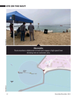
The Navy provided a target and the port provided a realistic operating envi- ronment. The industry team employed a small unmanned vessel as a force mul- tiplier to provide an initial non-lethal response to a threat approaching the entrance to the Port of Hueneme, simu- lated by a Navy High-Speed Maneuver- ing Surface Target (HSMST) boat — that had to be slowed so security forces could get the boat to safely exit the area.
These companies had not worked with each other before, but their solution suc- cessfully met the goals of the scenario.
The demonstration took place during intermittent thick fog at the harbor en- trance, underscoring the importance of executing the scenario together in a real- world setting, and with representatives of several warfare centers observing.
Each of the team members brough their own specialized technology and capabil- ity. SpotterRF’s C550 perimeter surveil- lance radar detected and tracked a target and passed information to the command and control (C2) hub developed by ION, which used their Marlin platform tech- nology to plan and execute the missions for the Theiss UAV. The UAV was ? tted with a command-initiated device that discharged and arresting line in front of the vessel at the precise time and loca- tion computed the C2 system. The radar data enabled a constantly updated solu- tion. The drone ? ew in front of the target and autonomously deployed the arrest- ing line, which slowed the target boat. www.marinetechnologynews.com 13
MTR #8 (1-17).indd 13 11/23/2021 2:45:20 PM