Page 10: of Marine Technology Magazine (Jan/Feb 2026)
Read this page in Pdf, Flash or Html5 edition of Jan/Feb 2026 Marine Technology Magazine
 9
9
 11
11
SUBSEA DEFENSE
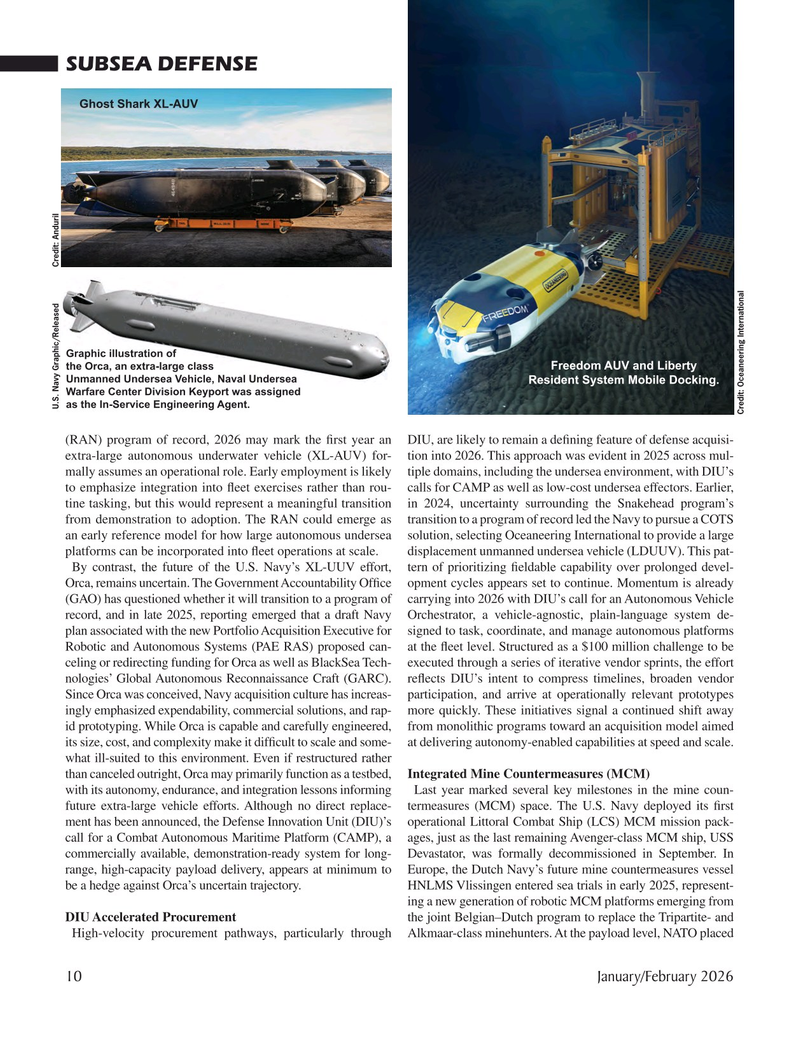
Ghost Shark XL-AUV
Graphic illustration of
Freedom AUV and Liberty the Orca, an extra-large class
Unmanned Undersea Vehicle, Naval Undersea
Resident System Mobile Docking.
Warfare Center Division Keyport was assigned as the In-Service Engineering Agent.
U.S. Navy Graphic/Released Credit: Anduril
Credit: Oceaneering International (RAN) program of record, 2026 may mark the ? rst year an DIU, are likely to remain a de? ning feature of defense acquisi- extra-large autonomous underwater vehicle (XL-AUV) for- tion into 2026. This approach was evident in 2025 across mul- mally assumes an operational role. Early employment is likely tiple domains, including the undersea environment, with DIU’s to emphasize integration into ? eet exercises rather than rou- calls for CAMP as well as low-cost undersea effectors. Earlier, tine tasking, but this would represent a meaningful transition in 2024, uncertainty surrounding the Snakehead program’s from demonstration to adoption. The RAN could emerge as transition to a program of record led the Navy to pursue a COTS an early reference model for how large autonomous undersea solution, selecting Oceaneering International to provide a large platforms can be incorporated into ? eet operations at scale. displacement unmanned undersea vehicle (LDUUV). This pat-
By contrast, the future of the U.S. Navy’s XL-UUV effort, tern of prioritizing ? eldable capability over prolonged devel-
Orca, remains uncertain. The Government Accountability Of? ce opment cycles appears set to continue. Momentum is already (GAO) has questioned whether it will transition to a program of carrying into 2026 with DIU’s call for an Autonomous Vehicle record, and in late 2025, reporting emerged that a draft Navy Orchestrator, a vehicle-agnostic, plain-language system de- plan associated with the new Portfolio Acquisition Executive for signed to task, coordinate, and manage autonomous platforms
Robotic and Autonomous Systems (PAE RAS) proposed can- at the ? eet level. Structured as a $100 million challenge to be celing or redirecting funding for Orca as well as BlackSea Tech- executed through a series of iterative vendor sprints, the effort nologies’ Global Autonomous Reconnaissance Craft (GARC). re? ects DIU’s intent to compress timelines, broaden vendor
Since Orca was conceived, Navy acquisition culture has increas- participation, and arrive at operationally relevant prototypes ingly emphasized expendability, commercial solutions, and rap- more quickly. These initiatives signal a continued shift away id prototyping. While Orca is capable and carefully engineered, from monolithic programs toward an acquisition model aimed its size, cost, and complexity make it dif? cult to scale and some- at delivering autonomy-enabled capabilities at speed and scale.
what ill-suited to this environment. Even if restructured rather than canceled outright, Orca may primarily function as a testbed, Integrated Mine Countermeasures (MCM) with its autonomy, endurance, and integration lessons informing Last year marked several key milestones in the mine coun- future extra-large vehicle efforts. Although no direct replace- termeasures (MCM) space. The U.S. Navy deployed its ? rst ment has been announced, the Defense Innovation Unit (DIU)’s operational Littoral Combat Ship (LCS) MCM mission pack- call for a Combat Autonomous Maritime Platform (CAMP), a ages, just as the last remaining Avenger-class MCM ship, USS commercially available, demonstration-ready system for long- Devastator, was formally decommissioned in September. In range, high-capacity payload delivery, appears at minimum to Europe, the Dutch Navy’s future mine countermeasures vessel be a hedge against Orca’s uncertain trajectory. HNLMS Vlissingen entered sea trials in early 2025, represent- ing a new generation of robotic MCM platforms emerging from
DIU Accelerated Procurement the joint Belgian–Dutch program to replace the Tripartite- and
High-velocity procurement pathways, particularly through Alkmaar-class minehunters. At the payload level, NATO placed 10 January/February 2026
MTR #1 (1-17).indd 10 MTR #1 (1-17).indd 10 2/11/2026 11:20:24 AM2/11/2026 11:20:24 AM