Page 12: of Marine Technology Magazine (Jan/Feb 2026)
Read this page in Pdf, Flash or Html5 edition of Jan/Feb 2026 Marine Technology Magazine
 11
11
 13
13
SUBSEA DEFENSE
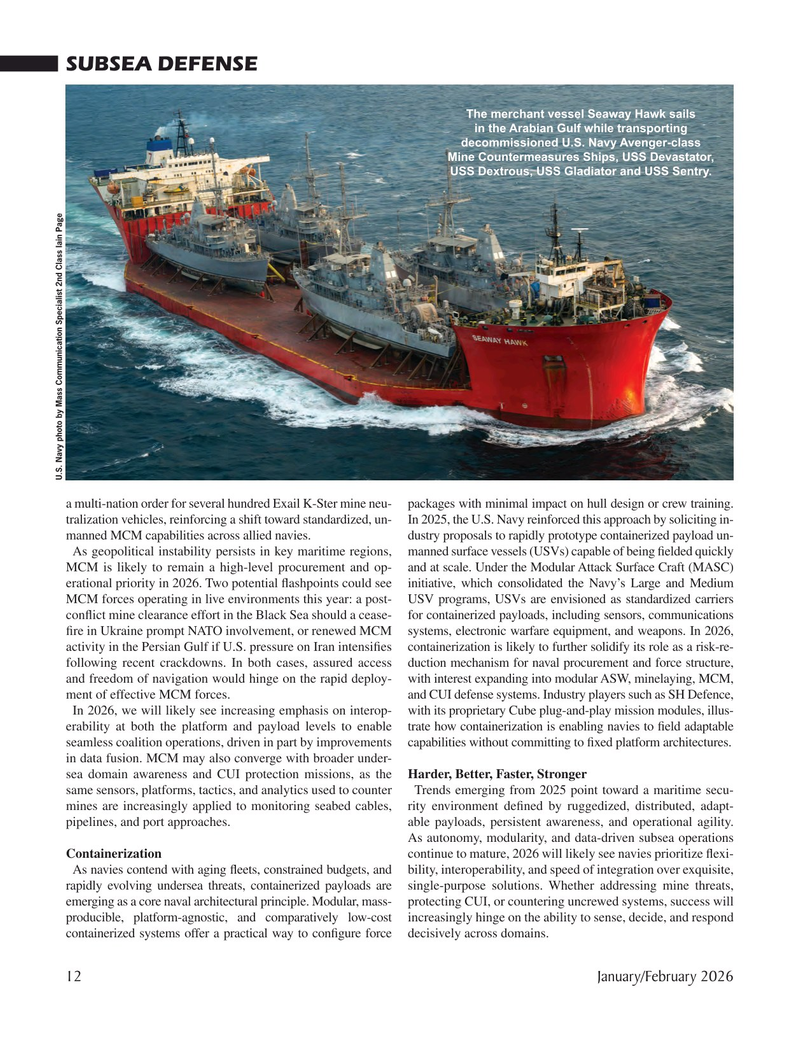
The merchant vessel Seaway Hawk sails in the Arabian Gulf while transporting decommissioned U.S. Navy Avenger-class
Mine Countermeasures Ships, USS Devastator,
USS Dextrous, USS Gladiator and USS Sentry.
U.S. Navy photo by Mass Communication Specialist 2nd Class Iain Page a multi-nation order for several hundred Exail K-Ster mine neu- packages with minimal impact on hull design or crew training. tralization vehicles, reinforcing a shift toward standardized, un- In 2025, the U.S. Navy reinforced this approach by soliciting in- manned MCM capabilities across allied navies. dustry proposals to rapidly prototype containerized payload un-
As geopolitical instability persists in key maritime regions, manned surface vessels (USVs) capable of being ? elded quickly
MCM is likely to remain a high-level procurement and op- and at scale. Under the Modular Attack Surface Craft (MASC) erational priority in 2026. Two potential ? ashpoints could see initiative, which consolidated the Navy’s Large and Medium
MCM forces operating in live environments this year: a post- USV programs, USVs are envisioned as standardized carriers con? ict mine clearance effort in the Black Sea should a cease- for containerized payloads, including sensors, communications ? re in Ukraine prompt NATO involvement, or renewed MCM systems, electronic warfare equipment, and weapons. In 2026, activity in the Persian Gulf if U.S. pressure on Iran intensi? es containerization is likely to further solidify its role as a risk-re- following recent crackdowns. In both cases, assured access duction mechanism for naval procurement and force structure, and freedom of navigation would hinge on the rapid deploy- with interest expanding into modular ASW, minelaying, MCM, ment of effective MCM forces. and CUI defense systems. Industry players such as SH Defence,
In 2026, we will likely see increasing emphasis on interop- with its proprietary Cube plug-and-play mission modules, illus- erability at both the platform and payload levels to enable trate how containerization is enabling navies to ? eld adaptable seamless coalition operations, driven in part by improvements capabilities without committing to ? xed platform architectures.
in data fusion. MCM may also converge with broader under- sea domain awareness and CUI protection missions, as the Harder, Better, Faster, Stronger same sensors, platforms, tactics, and analytics used to counter Trends emerging from 2025 point toward a maritime secu- mines are increasingly applied to monitoring seabed cables, rity environment de? ned by ruggedized, distributed, adapt- pipelines, and port approaches. able payloads, persistent awareness, and operational agility.
As autonomy, modularity, and data-driven subsea operations
Containerization continue to mature, 2026 will likely see navies prioritize ? exi-
As navies contend with aging ? eets, constrained budgets, and bility, interoperability, and speed of integration over exquisite, rapidly evolving undersea threats, containerized payloads are single-purpose solutions. Whether addressing mine threats, emerging as a core naval architectural principle. Modular, mass- protecting CUI, or countering uncrewed systems, success will producible, platform-agnostic, and comparatively low-cost increasingly hinge on the ability to sense, decide, and respond containerized systems offer a practical way to con? gure force decisively across domains.
12 January/February 2026
MTR #1 (1-17).indd 12 MTR #1 (1-17).indd 12 2/11/2026 11:21:46 AM2/11/2026 11:21:46 AM