Page 19: of Marine Technology Magazine (Jan/Feb 2026)
Read this page in Pdf, Flash or Html5 edition of Jan/Feb 2026 Marine Technology Magazine
 18
18
 20
20
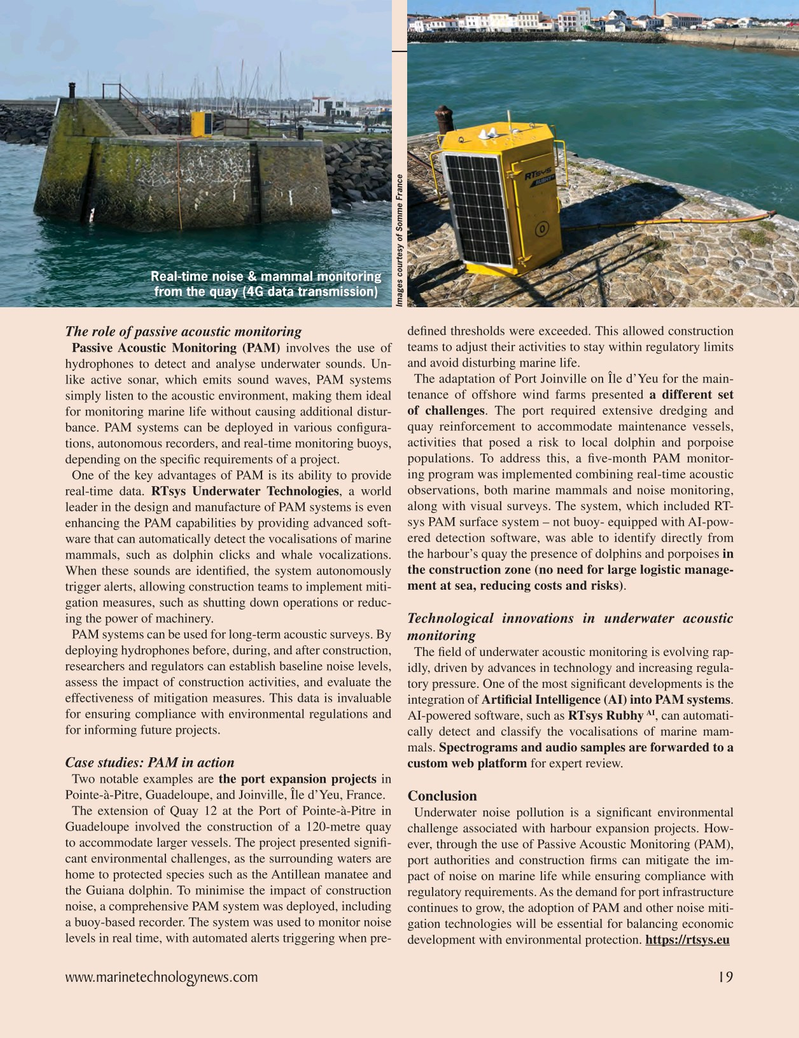
Real-time noise & mammal monitoring from the quay (4G data transmission)
Images courtesy of Somme France de? ned thresholds were exceeded. This allowed construction
The role of passive acoustic monitoring
Passive Acoustic Monitoring (PAM) involves the use of teams to adjust their activities to stay within regulatory limits hydrophones to detect and analyse underwater sounds. Un- and avoid disturbing marine life. like active sonar, which emits sound waves, PAM systems The adaptation of Port Joinville on Île d’Yeu for the main- simply listen to the acoustic environment, making them ideal tenance of offshore wind farms presented a different set for monitoring marine life without causing additional distur- of challenges. The port required extensive dredging and bance. PAM systems can be deployed in various con? gura- quay reinforcement to accommodate maintenance vessels, tions, autonomous recorders, and real-time monitoring buoys, activities that posed a risk to local dolphin and porpoise depending on the speci? c requirements of a project. populations. To address this, a ? ve-month PAM monitor-
One of the key advantages of PAM is its ability to provide ing program was implemented combining real-time acoustic real-time data. RTsys Underwater Technologies, a world observations, both marine mammals and noise monitoring, leader in the design and manufacture of PAM systems is even along with visual surveys. The system, which included RT- enhancing the PAM capabilities by providing advanced soft- sys PAM surface system – not buoy- equipped with AI-pow- ware that can automatically detect the vocalisations of marine ered detection software, was able to identify directly from mammals, such as dolphin clicks and whale vocalizations. the harbour’s quay the presence of dolphins and porpoises in
When these sounds are identi? ed, the system autonomously the construction zone (no need for large logistic manage- trigger alerts, allowing construction teams to implement miti- ment at sea, reducing costs and risks).
gation measures, such as shutting down operations or reduc- ing the power of machinery.
Technological innovations in underwater acoustic
PAM systems can be used for long-term acoustic surveys. By monitoring deploying hydrophones before, during, and after construction,
The ? eld of underwater acoustic monitoring is evolving rap- researchers and regulators can establish baseline noise levels, idly, driven by advances in technology and increasing regula- assess the impact of construction activities, and evaluate the tory pressure. One of the most signi? cant developments is the effectiveness of mitigation measures. This data is invaluable integration of Arti? cial Intelligence (AI) into PAM systems.
AI for ensuring compliance with environmental regulations and AI-powered software, such as RTsys Rubhy , can automati- for informing future projects.
cally detect and classify the vocalisations of marine mam- mals. Spectrograms and audio samples are forwarded to a
Case studies: PAM in action custom web platform for expert review.
Two notable examples are the port expansion projects in
Pointe-à-Pitre, Guadeloupe, and Joinville, Île d’Yeu, France.
Conclusion
The extension of Quay 12 at the Port of Pointe-à-Pitre in
Underwater noise pollution is a signi? cant environmental
Guadeloupe involved the construction of a 120-metre quay challenge associated with harbour expansion projects. How- to accommodate larger vessels. The project presented signi? - ever, through the use of Passive Acoustic Monitoring (PAM), cant environmental challenges, as the surrounding waters are port authorities and construction ? rms can mitigate the im- home to protected species such as the Antillean manatee and pact of noise on marine life while ensuring compliance with the Guiana dolphin. To minimise the impact of construction regulatory requirements. As the demand for port infrastructure noise, a comprehensive PAM system was deployed, including continues to grow, the adoption of PAM and other noise miti- a buoy-based recorder. The system was used to monitor noise gation technologies will be essential for balancing economic levels in real time, with automated alerts triggering when pre- development with environmental protection. https://rtsys.eu www.marinetechnologynews.com 19
MTR #1 (18-33).indd 19 MTR #1 (18-33).indd 19 2/10/2026 4:02:16 PM2/10/2026 4:02:16 PM