Page 36: of Marine Technology Magazine (Jan/Feb 2026)
Read this page in Pdf, Flash or Html5 edition of Jan/Feb 2026 Marine Technology Magazine
 35
35
 37
37
FEATURE ATOMIC CLOCKS “The solution to navigation accuracy was – and still is – precise timing.” – Alexander Jantzen,
Co-founder & Chief
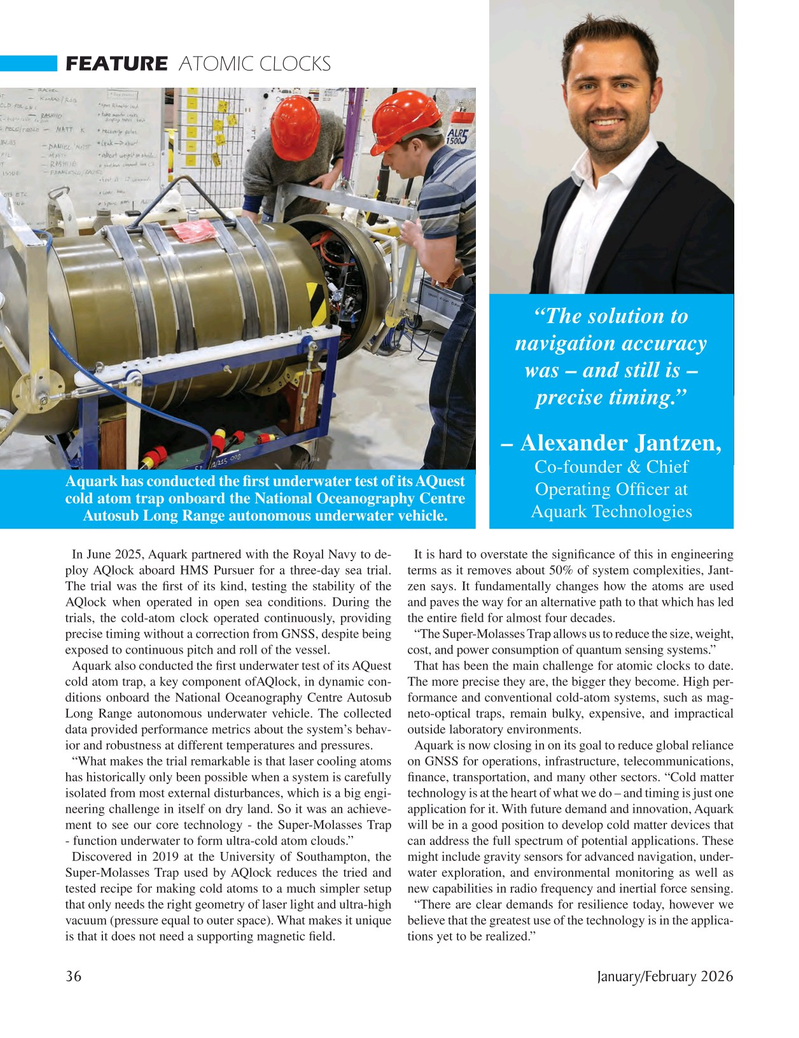
Aquark has conducted the ? rst underwater test of its AQuest
Operating Of? cer at cold atom trap onboard the National Oceanography Centre
Aquark Technologies
Autosub Long Range autonomous underwater vehicle.
In June 2025, Aquark partnered with the Royal Navy to de- It is hard to overstate the signi? cance of this in engineering ploy AQlock aboard HMS Pursuer for a three-day sea trial. terms as it removes about 50% of system complexities, Jant-
The trial was the ? rst of its kind, testing the stability of the zen says. It fundamentally changes how the atoms are used
AQlock when operated in open sea conditions. During the and paves the way for an alternative path to that which has led trials, the cold-atom clock operated continuously, providing the entire ? eld for almost four decades. precise timing without a correction from GNSS, despite being “The Super-Molasses Trap allows us to reduce the size, weight, exposed to continuous pitch and roll of the vessel. cost, and power consumption of quantum sensing systems.”
Aquark also conducted the ? rst underwater test of its AQuest That has been the main challenge for atomic clocks to date. cold atom trap, a key component ofAQlock, in dynamic con- The more precise they are, the bigger they become. High per- ditions onboard the National Oceanography Centre Autosub formance and conventional cold-atom systems, such as mag-
Long Range autonomous underwater vehicle. The collected neto-optical traps, remain bulky, expensive, and impractical data provided performance metrics about the system’s behav- outside laboratory environments. ior and robustness at different temperatures and pressures. Aquark is now closing in on its goal to reduce global reliance “What makes the trial remarkable is that laser cooling atoms on GNSS for operations, infrastructure, telecommunications, has historically only been possible when a system is carefully ? nance, transportation, and many other sectors. “Cold matter isolated from most external disturbances, which is a big engi- technology is at the heart of what we do – and timing is just one neering challenge in itself on dry land. So it was an achieve- application for it. With future demand and innovation, Aquark ment to see our core technology - the Super-Molasses Trap will be in a good position to develop cold matter devices that - function underwater to form ultra-cold atom clouds.” can address the full spectrum of potential applications. These
Discovered in 2019 at the University of Southampton, the might include gravity sensors for advanced navigation, under-
Super-Molasses Trap used by AQlock reduces the tried and water exploration, and environmental monitoring as well as tested recipe for making cold atoms to a much simpler setup new capabilities in radio frequency and inertial force sensing. that only needs the right geometry of laser light and ultra-high “There are clear demands for resilience today, however we vacuum (pressure equal to outer space). What makes it unique believe that the greatest use of the technology is in the applica- is that it does not need a supporting magnetic ? eld. tions yet to be realized.” 36 January/February 2026
MTR #1 (34-49).indd 36 MTR #1 (34-49).indd 36 2/11/2026 11:54:32 AM2/11/2026 11:54:32 AM