Page 50: of Marine Technology Magazine (Jan/Feb 2026)
Read this page in Pdf, Flash or Html5 edition of Jan/Feb 2026 Marine Technology Magazine
 49
49
 51
51
TECH FEATURE AUTOMATIC DOCKING
Automatic docking as an enabling technology for the operational autonomy of underwater systems or a long time, the operational autonomy of un- designed to support automatic alignment, battery recharging, derwater systems has been constrained by the in- bidirectional data transfer and the updating of mission param- ability to ensure persistent operations without di- eters. Docking stations constitute key infrastructural nodes rect human intervention. Autonomous Underwater within advanced marine observation systems, allowing a re-
FVehicles (AUVs), while capable of carrying out duction in dependence on surface operations and an increase pre-programmed missions along the water column or on the in the overall duration of data acquisition campaigns.
seabed, have historically required physical recovery at the end The evolution of docking technology has followed a gradual of each operational cycle for energy recharging, data transfer path: from early manual or assisted solutions, which required and mission recon? guration. signi? cant operator support, to more recent implementations of
This dependence on surface operations has represented one of automatic docking. The latter are based on precision navigation the main bottlenecks in the development of long-term marine ob- systems, acoustic and optical proximity sensors, advanced con- servation infrastructures, signi? cantly limiting their effectiveness, trol algorithms and autonomous decision-making logics, capa- continuity and scalability. Within this context, underwater dock- ble of robustly managing the approach, capture and disconnec- ing technology emerges as a key enabling factor: the introduction tion phases even under challenging environmental conditions.
of docking stations makes it possible to overcome the traditional Automatic docking does not represent a mere incremental operational paradigm, radically extending the autonomy of AUVs improvement, but rather a paradigm shift, as it enables the and enabling the deployment of persistent, distributed monitoring transformation of the AUV from a mission-based platform architectures with a high level of operational reliability. into an element of a persistent system, capable of operating for extended periods without human intervention.
Underwater docking technology
Underwater docking enables an AUV to perform approach EdgeLab and the progressive development of and berthing manoeuvres towards a dedicated subsea station, docking technology
EdgeLab S.p.A., an innovative SME with its operational head- quarters in La Spezia, operates in the ? eld of advanced marine technologies, with a particular focus on the design of autono- mous underwater vehicles and integrated systems for scienti? c, industrial and security applications. Over recent years, EdgeLab has systematically addressed the challenge of underwater dock- ing through participation in European Union–funded research and innovation projects, developing a progressive technological pathway that has led from the implementation of manual solu- tions to the validation of automatic docking architectures.
Two projects, in particular, represent the main milestones of this technological evolution: NAUTILOS and M.A.R.E.
NAUTILOS: validation of manual docking in the context of sustainable marine observation
The NAUTILOS project, funded under the European Union’s
Horizon 2020 research and innovation programme, is focused on the development and demonstration of innovative technologies for the measurement of Essential Ocean Variables (EOVs), with the aim of addressing existing gaps in the observation of physi- cal, chemical, biological and deep-ocean variables. The project
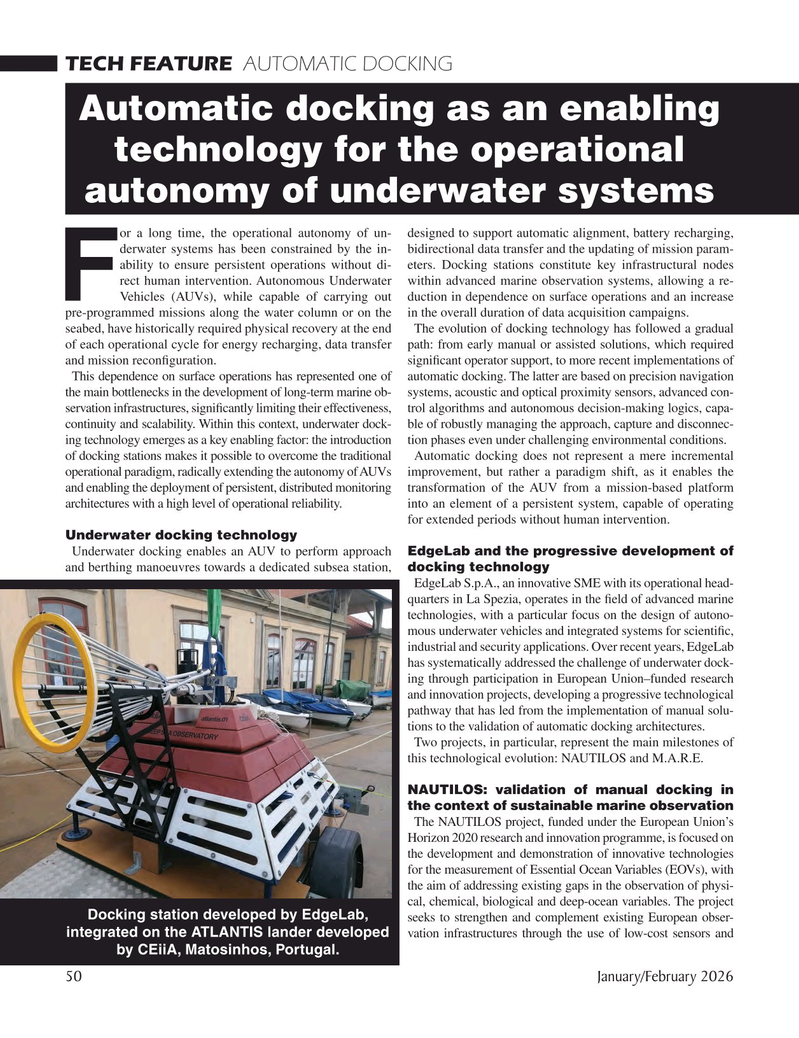
Docking station developed by EdgeLab, seeks to strengthen and complement existing European obser- integrated on the ATLANTIS lander developed vation infrastructures through the use of low-cost sensors and by CEiiA, Matosinhos, Portugal.
50 January/February 2026
MTR #1 (50-63).indd 50 MTR #1 (50-63).indd 50 2/11/2026 11:47:38 AM2/11/2026 11:47:38 AM