Page 10: of Marine Technology Magazine (Mar/Apr 2026)
Read this page in Pdf, Flash or Html5 edition of Mar/Apr 2026 Marine Technology Magazine
 9
9
 11
11
SUBSEA DEFENSE
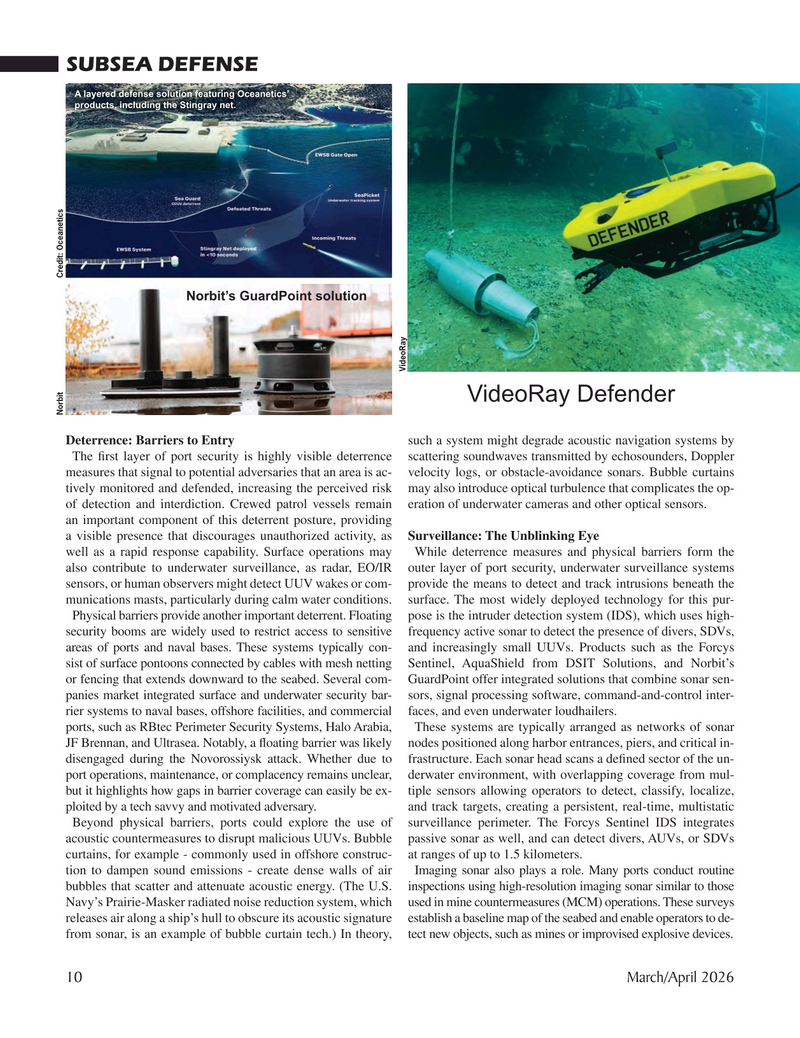
A layered defense solution featuring Oceanetics’ products, including the Stingray net.
Norbit’s GuardPoint solution
VideoRay
VideoRay Defender
Norbit Credit: Oceanetics
Deterrence: Barriers to Entry such a system might degrade acoustic navigation systems by
The ? rst layer of port security is highly visible deterrence scattering soundwaves transmitted by echosounders, Doppler measures that signal to potential adversaries that an area is ac- velocity logs, or obstacle-avoidance sonars. Bubble curtains tively monitored and defended, increasing the perceived risk may also introduce optical turbulence that complicates the op- of detection and interdiction. Crewed patrol vessels remain eration of underwater cameras and other optical sensors.
an important component of this deterrent posture, providing a visible presence that discourages unauthorized activity, as Surveillance: The Unblinking Eye well as a rapid response capability. Surface operations may While deterrence measures and physical barriers form the also contribute to underwater surveillance, as radar, EO/IR outer layer of port security, underwater surveillance systems sensors, or human observers might detect UUV wakes or com- provide the means to detect and track intrusions beneath the munications masts, particularly during calm water conditions. surface. The most widely deployed technology for this pur-
Physical barriers provide another important deterrent. Floating pose is the intruder detection system (IDS), which uses high- security booms are widely used to restrict access to sensitive frequency active sonar to detect the presence of divers, SDVs, areas of ports and naval bases. These systems typically con- and increasingly small UUVs. Products such as the Forcys sist of surface pontoons connected by cables with mesh netting Sentinel, AquaShield from DSIT Solutions, and Norbit’s or fencing that extends downward to the seabed. Several com- GuardPoint offer integrated solutions that combine sonar sen- panies market integrated surface and underwater security bar- sors, signal processing software, command-and-control inter- rier systems to naval bases, offshore facilities, and commercial faces, and even underwater loudhailers.
ports, such as RBtec Perimeter Security Systems, Halo Arabia, These systems are typically arranged as networks of sonar
JF Brennan, and Ultrasea. Notably, a ? oating barrier was likely nodes positioned along harbor entrances, piers, and critical in- disengaged during the Novorossiysk attack. Whether due to frastructure. Each sonar head scans a de? ned sector of the un- port operations, maintenance, or complacency remains unclear, derwater environment, with overlapping coverage from mul- but it highlights how gaps in barrier coverage can easily be ex- tiple sensors allowing operators to detect, classify, localize, ploited by a tech savvy and motivated adversary. and track targets, creating a persistent, real-time, multistatic
Beyond physical barriers, ports could explore the use of surveillance perimeter. The Forcys Sentinel IDS integrates acoustic countermeasures to disrupt malicious UUVs. Bubble passive sonar as well, and can detect divers, AUVs, or SDVs curtains, for example - commonly used in offshore construc- at ranges of up to 1.5 kilometers. tion to dampen sound emissions - create dense walls of air Imaging sonar also plays a role. Many ports conduct routine bubbles that scatter and attenuate acoustic energy. (The U.S. inspections using high-resolution imaging sonar similar to those
Navy’s Prairie-Masker radiated noise reduction system, which used in mine countermeasures (MCM) operations. These surveys releases air along a ship’s hull to obscure its acoustic signature establish a baseline map of the seabed and enable operators to de- from sonar, is an example of bubble curtain tech.) In theory, tect new objects, such as mines or improvised explosive devices.
10 March/April 2026
MTR #3 (1-17).indd 10 MTR #3 (1-17).indd 10 3/30/2026 12:10:36 PM3/30/2026 12:10:36 PM