Page 38: of Maritime Reporter Magazine (February 16, 2026)
Read this page in Pdf, Flash or Html5 edition of February 16, 2026 Maritime Reporter Magazine
 37
37
 39
39
feature
Hydrogen Ready Catamaran
Hydrogen-Ready — What That Really Means “Hydrogen-ready” is often used loosely in shipping. In Ho- rizon X’s case, it is tied to a de? ned development pathway.
Siemens has been working on hydrogen combustion in the
SGT-400 for more than a decade. According to project docu- mentation, the platform achieved 100% hydrogen operation in 2023 under the EU-funded HYFLEXPOWER project, with further testing ongoing.
The turbine features a Dry Low Emissions (DLE) system and is designed to meet IMO Tier III NOx limits without
SCR. A new combustor con? guration allows operation on 100% hydrogen, 100% natural gas/LNG, or blends be- tween, with retro? t potential and minimal changes to the turbine core.
But Moberg is clear: the engine is only part of the equation.
“If you’re talking hydrogen, you need a complete arrange- ment in order to get it on board,” he says.
Hydrogen’s small molecular size, storage challenges and safety requirements mean that fuel handling systems de? ne practical fuel ? exibility. Designing a ship capable of storing
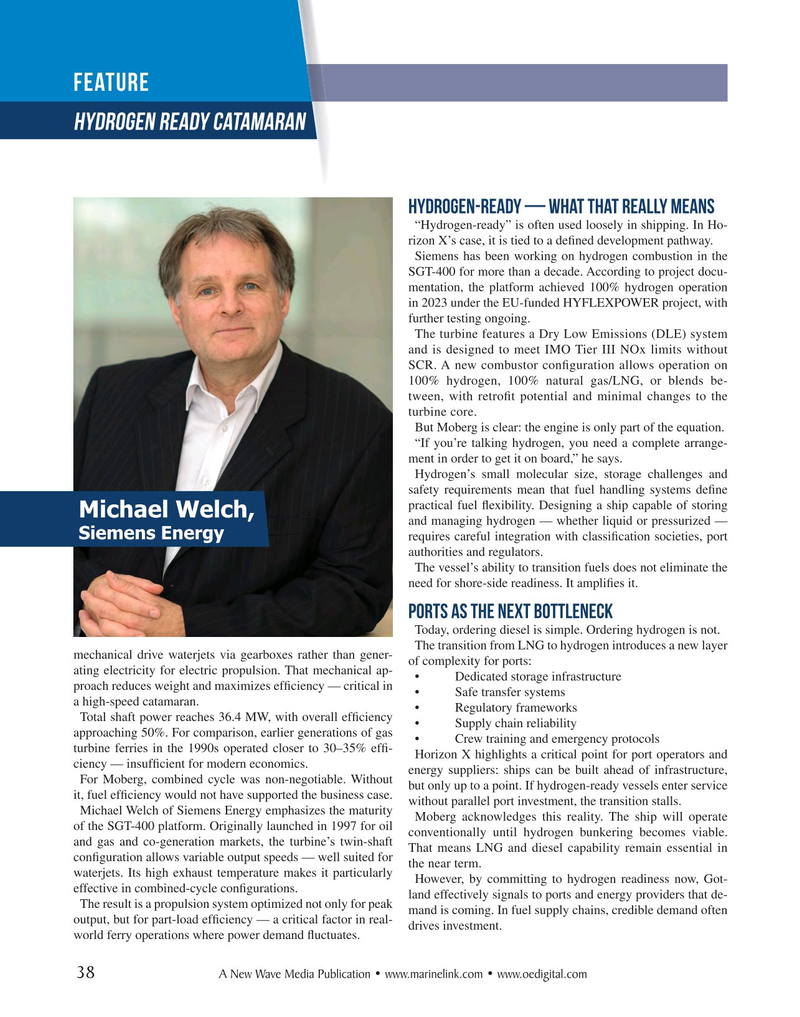
Michael Welch, and managing hydrogen — whether liquid or pressurized —
Siemens Energy requires careful integration with classi? cation societies, port authorities and regulators.
The vessel’s ability to transition fuels does not eliminate the need for shore-side readiness. It ampli? es it.
Ports as the Next Bottleneck
Today, ordering diesel is simple. Ordering hydrogen is not.
The transition from LNG to hydrogen introduces a new layer mechanical drive waterjets via gearboxes rather than gener- of complexity for ports: ating electricity for electric propulsion. That mechanical ap- • Dedicated storage infrastructure proach reduces weight and maximizes ef? ciency — critical in • Safe transfer systems a high-speed catamaran.
• Regulatory frameworks
Total shaft power reaches 36.4 MW, with overall ef? ciency • Supply chain reliability approaching 50%. For comparison, earlier generations of gas • Crew training and emergency protocols turbine ferries in the 1990s operated closer to 30–35% ef? -
Horizon X highlights a critical point for port operators and ciency — insuf? cient for modern economics.
energy suppliers: ships can be built ahead of infrastructure,
For Moberg, combined cycle was non-negotiable. Without but only up to a point. If hydrogen-ready vessels enter service it, fuel ef? ciency would not have supported the business case.
without parallel port investment, the transition stalls.
Michael Welch of Siemens Energy emphasizes the maturity
Moberg acknowledges this reality. The ship will operate of the SGT-400 platform. Originally launched in 1997 for oil conventionally until hydrogen bunkering becomes viable. and gas and co-generation markets, the turbine’s twin-shaft That means LNG and diesel capability remain essential in con? guration allows variable output speeds — well suited for the near term.
waterjets. Its high exhaust temperature makes it particularly
However, by committing to hydrogen readiness now, Got- effective in combined-cycle con? gurations.
land effectively signals to ports and energy providers that de-
The result is a propulsion system optimized not only for peak mand is coming. In fuel supply chains, credible demand often output, but for part-load ef? ciency — a critical factor in real- drives investment.
world ferry operations where power demand ? uctuates.
38 A New Wave Media Publication • www.marinelink.com • www.oedigital.com 2026_PortoftheFuture_34-48.indd 38 2026_PortoftheFuture_34-48.indd 38 3/3/2026 4:25:02 PM3/3/2026 4:25:02 PM