Page 35: of Maritime Reporter Magazine (April 2026)
Read this page in Pdf, Flash or Html5 edition of April 2026 Maritime Reporter Magazine
 34
34
 36
36
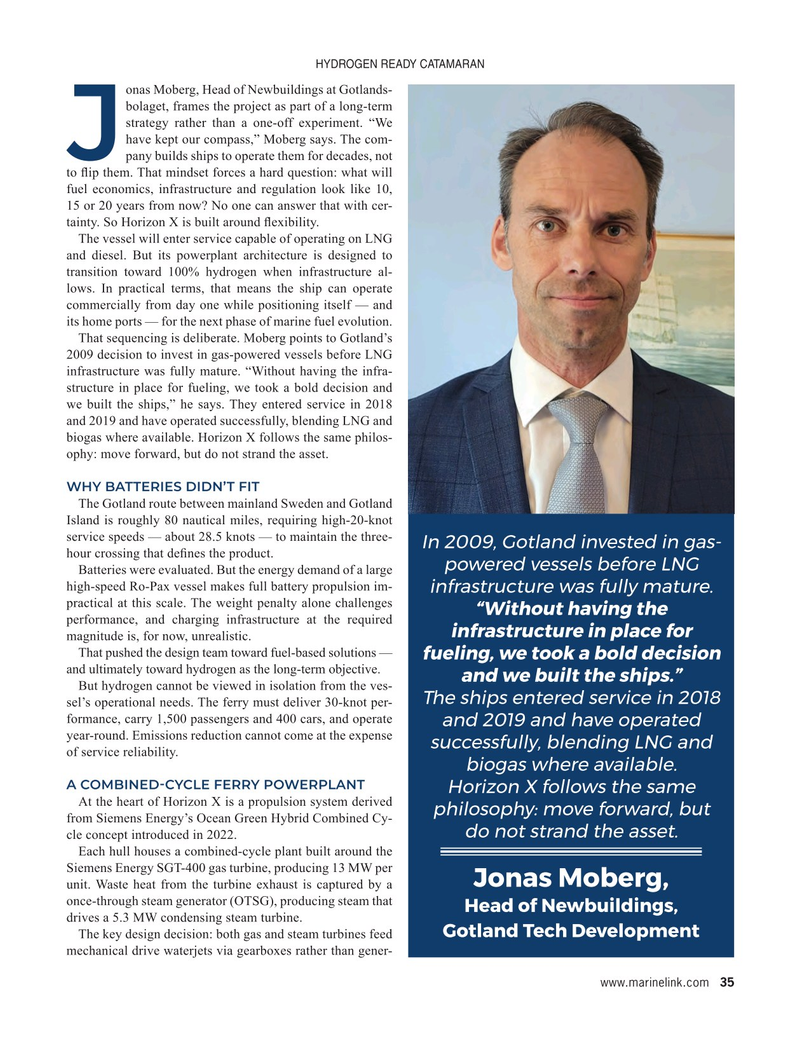
HYDROGEN READY CATAMARAN onas Moberg, Head of Newbuildings at Gotlands- bolaget, frames the project as part of a long-term strategy rather than a one-off experiment. “We have kept our compass,” Moberg says. The com-
J pany builds ships to operate them for decades, not to ? ip them. That mindset forces a hard question: what will fuel economics, infrastructure and regulation look like 10, 15 or 20 years from now? No one can answer that with cer- tainty. So Horizon X is built around ? exibility.
The vessel will enter service capable of operating on LNG and diesel. But its powerplant architecture is designed to transition toward 100% hydrogen when infrastructure al- lows. In practical terms, that means the ship can operate commercially from day one while positioning itself — and its home ports — for the next phase of marine fuel evolution.
That sequencing is deliberate. Moberg points to Gotland’s 2009 decision to invest in gas-powered vessels before LNG infrastructure was fully mature. “Without having the infra- structure in place for fueling, we took a bold decision and we built the ships,” he says. They entered service in 2018 and 2019 and have operated successfully, blending LNG and biogas where available. Horizon X follows the same philos- ophy: move forward, but do not strand the asset.
WHY BATTERIES DIDN’T FIT
The Gotland route between mainland Sweden and Gotland
Island is roughly 80 nautical miles, requiring high-20-knot service speeds — about 28.5 knots — to maintain the three-
In 2009, Gotland invested in gas- hour crossing that de? nes the product.
powered vessels before LNG
Batteries were evaluated. But the energy demand of a large high-speed Ro-Pax vessel makes full battery propulsion im- infrastructure was fully mature.
practical at this scale. The weight penalty alone challenges “Without having the performance, and charging infrastructure at the required infrastructure in place for magnitude is, for now, unrealistic.
That pushed the design team toward fuel-based solutions — fueling, we took a bold decision and ultimately toward hydrogen as the long-term objective.
and we built the ships.”
But hydrogen cannot be viewed in isolation from the ves-
The ships entered service in 2018 sel’s operational needs. The ferry must deliver 30-knot per- formance, carry 1,500 passengers and 400 cars, and operate and 2019 and have operated year-round. Emissions reduction cannot come at the expense successfully, blending LNG and of service reliability.
biogas where available.
A COMBINED-CYCLE FERRY POWERPLANT
Horizon X follows the same
At the heart of Horizon X is a propulsion system derived philosophy: move forward, but from Siemens Energy’s Ocean Green Hybrid Combined Cy- do not strand the asset.
cle concept introduced in 2022.
Each hull houses a combined-cycle plant built around the
Siemens Energy SGT-400 gas turbine, producing 13 MW per
Jonas Moberg, unit. Waste heat from the turbine exhaust is captured by a once-through steam generator (OTSG), producing steam that
Head of Newbuildings, drives a 5.3 MW condensing steam turbine.
Gotland Tech Development
The key design decision: both gas and steam turbines feed mechanical drive waterjets via gearboxes rather than gener- www.marinelink.com 35
MR #4 (34-49).indd 35 MR #4 (34-49).indd 35 4/2/2026 10:29:12 AM4/2/2026 10:29:12 AM