Page 48: of Maritime Reporter Magazine (April 2026)
Read this page in Pdf, Flash or Html5 edition of April 2026 Maritime Reporter Magazine
 47
47
 49
49
SHIPBUILDING
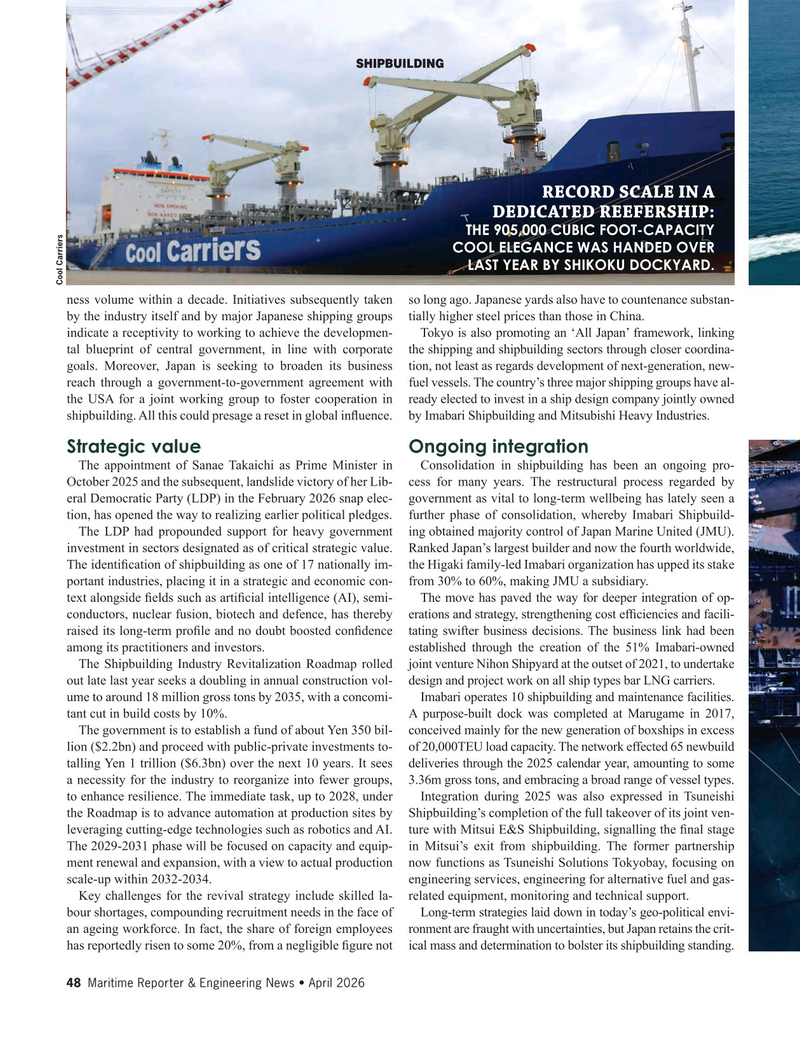
RECORD SCALE IN A
DEDICATED REEFERSHIP:
THE 905,000 CUBIC FOOT-CAPACITY
COOL ELEGANCE WAS HANDED OVER
LAST YEAR BY SHIKOKU DOCKYARD.
Cool Carriers ness volume within a decade. Initiatives subsequently taken so long ago. Japanese yards also have to countenance substan- by the industry itself and by major Japanese shipping groups tially higher steel prices than those in China. indicate a receptivity to working to achieve the developmen- Tokyo is also promoting an ‘All Japan’ framework, linking tal blueprint of central government, in line with corporate the shipping and shipbuilding sectors through closer coordina- goals. Moreover, Japan is seeking to broaden its business tion, not least as regards development of next-generation, new- reach through a government-to-government agreement with fuel vessels. The country’s three major shipping groups have al- the USA for a joint working group to foster cooperation in ready elected to invest in a ship design company jointly owned shipbuilding. All this could presage a reset in global in? uence. by Imabari Shipbuilding and Mitsubishi Heavy Industries.
Strategic value Ongoing integration
The appointment of Sanae Takaichi as Prime Minister in Consolidation in shipbuilding has been an ongoing pro-
October 2025 and the subsequent, landslide victory of her Lib- cess for many years. The restructural process regarded by eral Democratic Party (LDP) in the February 2026 snap elec- government as vital to long-term wellbeing has lately seen a tion, has opened the way to realizing earlier political pledges. further phase of consolidation, whereby Imabari Shipbuild-
The LDP had propounded support for heavy government ing obtained majority control of Japan Marine United (JMU). investment in sectors designated as of critical strategic value. Ranked Japan’s largest builder and now the fourth worldwide,
The identi? cation of shipbuilding as one of 17 nationally im- the Higaki family-led Imabari organization has upped its stake portant industries, placing it in a strategic and economic con- from 30% to 60%, making JMU a subsidiary. text alongside ? elds such as arti? cial intelligence (AI), semi- The move has paved the way for deeper integration of op- conductors, nuclear fusion, biotech and defence, has thereby erations and strategy, strengthening cost ef? ciencies and facili- raised its long-term pro? le and no doubt boosted con? dence tating swifter business decisions. The business link had been among its practitioners and investors. established through the creation of the 51% Imabari-owned
The Shipbuilding Industry Revitalization Roadmap rolled joint venture Nihon Shipyard at the outset of 2021, to undertake out late last year seeks a doubling in annual construction vol- design and project work on all ship types bar LNG carriers. ume to around 18 million gross tons by 2035, with a concomi- Imabari operates 10 shipbuilding and maintenance facilities. tant cut in build costs by 10%. A purpose-built dock was completed at Marugame in 2017,
The government is to establish a fund of about Yen 350 bil- conceived mainly for the new generation of boxships in excess lion ($2.2bn) and proceed with public-private investments to- of 20,000TEU load capacity. The network effected 65 newbuild talling Yen 1 trillion ($6.3bn) over the next 10 years. It sees deliveries through the 2025 calendar year, amounting to some a necessity for the industry to reorganize into fewer groups, 3.36m gross tons, and embracing a broad range of vessel types.
to enhance resilience. The immediate task, up to 2028, under Integration during 2025 was also expressed in Tsuneishi the Roadmap is to advance automation at production sites by Shipbuilding’s completion of the full takeover of its joint ven- leveraging cutting-edge technologies such as robotics and AI. ture with Mitsui E&S Shipbuilding, signalling the ? nal stage
The 2029-2031 phase will be focused on capacity and equip- in Mitsui’s exit from shipbuilding. The former partnership ment renewal and expansion, with a view to actual production now functions as Tsuneishi Solutions Tokyobay, focusing on scale-up within 2032-2034. engineering services, engineering for alternative fuel and gas-
Key challenges for the revival strategy include skilled la- related equipment, monitoring and technical support. bour shortages, compounding recruitment needs in the face of Long-term strategies laid down in today’s geo-political envi- an ageing workforce. In fact, the share of foreign employees ronment are fraught with uncertainties, but Japan retains the crit- has reportedly risen to some 20%, from a negligible ? gure not ical mass and determination to bolster its shipbuilding standing. 48 Maritime Reporter & Engineering News • April 2026
MR #4 (34-49).indd 48 MR #4 (34-49).indd 48 4/2/2026 10:39:44 AM4/2/2026 10:39:44 AM