Page 26: of Marine Technology Magazine (Jan/Feb 2026)
Read this page in Pdf, Flash or Html5 edition of Jan/Feb 2026 Marine Technology Magazine
 25
25

 27
27
FEATURE AUSTRALIAN BUOYS
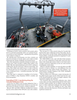
Above: GNSS-A equipped Wave Glider midships, loaded aboard the R/V North Wind in Eureka, CA, and surrounded by three sea? oor geodetic benchmarks to be deployed along the Cascadia Subduction Zone.
Right: Topo-bathymetry map of the Cascadia subduction zone showing geodetic velocities on land and offshore USGS and NSF sea? oor geodetic sites.
m horizontally in a shallow part of the fault, less than 20
Critical insights from the Aleutian subduction zone
One of the tectonic sources of large earthquakes that USGS km below the seabed, helping us to understand how stress has been monitoring is the Aleutian Subduction Zone. It was builds up along the fault and is released in an earthquake,” he here that the Chignik earthquake struck – and USGS was says. “These results suggested that the cumulative slip had ready for a post-earthquake response mission. relieved stress on the shallow portion of the fault and there-
Just a couple of years before, three GNSS-A monitoring sites fore, the Chignik earthquake likely did not increase tsunami had been set up on the sea