Page 16: of Maritime Reporter Magazine (February 16, 2026)
Read this page in Pdf, Flash or Html5 edition of February 16, 2026 Maritime Reporter Magazine
 15
15
 17
17
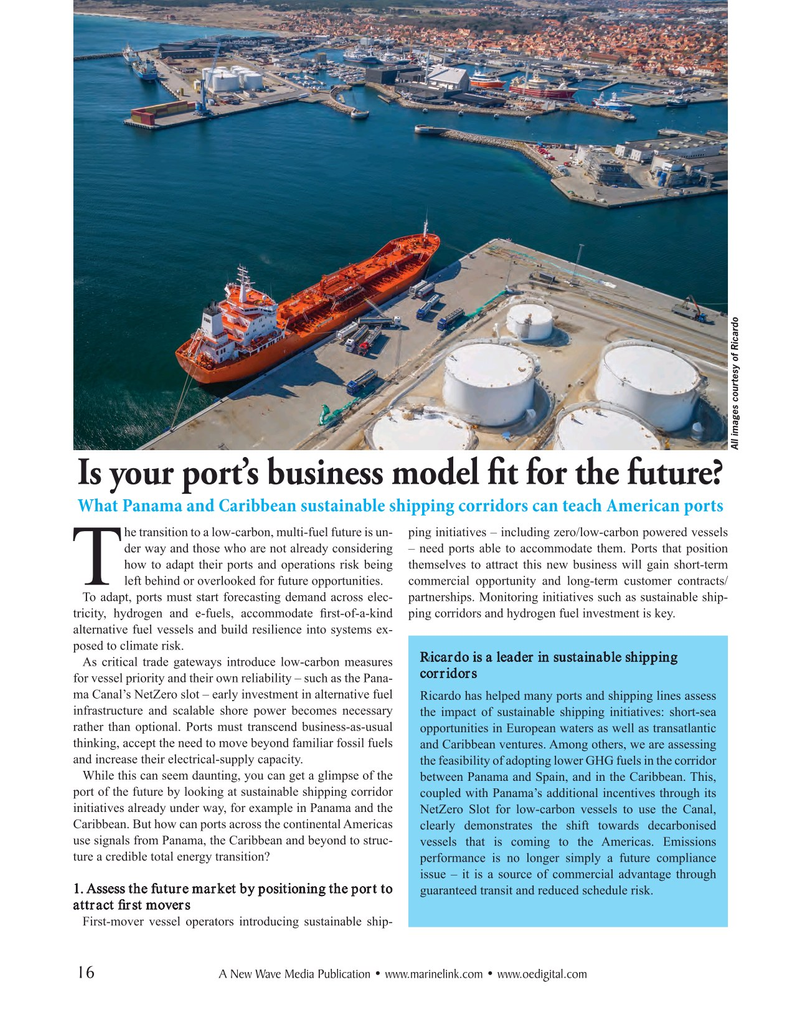
All images courtesy of Ricardo
Is your port’s business model f t for the future?
What Panama and Caribbean sustainable shipping corridors can teach American ports he transition to a low-carbon, multi-fuel future is un- ping initiatives – including zero/low-carbon powered vessels der way and those who are not already considering – need ports able to accommodate them. Ports that position how to adapt their ports and operations risk being themselves to attract this new business will gain short-term
T left behind or overlooked for future opportunities. commercial opportunity and long-term customer contracts/
To adapt, ports must start forecasting demand across elec- partnerships. Monitoring initiatives such as sustainable ship- tricity, hydrogen and e-fuels, accommodate ? rst-of-a-kind ping corridors and hydrogen fuel investment is key. alternative fuel vessels and build resilience into systems ex- posed to climate risk.
Ricardo is a leader in sustainable shipping
As critical trade gateways introduce low-carbon measures corridors for vessel priority and their own reliability – such as the Pana- ma Canal’s NetZero slot – early investment in alternative fuel
Ricardo has helped many ports and shipping lines assess infrastructure and scalable shore power becomes necessary the impact of sustainable shipping initiatives: short-sea rather than optional. Ports must transcend business-as-usual opportunities in European waters as well as transatlantic thinking, accept the need to move beyond familiar fossil fuels and Caribbean ventures. Among others, we are assessing and increase their electrical-supply capacity. the feasibility of adopting lower GHG fuels in the corridor
While this can seem daunting, you can get a glimpse of the between Panama and Spain, and in the Caribbean. This, port of the future by looking at sustainable shipping corridor coupled with Panama’s additional incentives through its initiatives already under way, for example in Panama and the
NetZero Slot for low-carbon vessels to use the Canal,
Caribbean. But how can ports across the continental Americas clearly demonstrates the shift towards decarbonised use signals from Panama, the Caribbean and beyond to struc- vessels that is coming to the Americas. Emissions ture a credible total energy transition?
performance is no longer simply a future compliance issue – it is a source of commercial advantage through 1. Assess the future market by positioning the port to guaranteed transit and reduced schedule risk. attract ? rst movers
First-mover vessel operators introducing sustainable ship- 16 A New Wave Media Publication • www.marinelink.com • www.oedigital.com 2026_PortoftheFuture_1-17.indd 16 2026_PortoftheFuture_1-17.indd 16 3/3/2026 3:38:49 PM3/3/2026 3:38:49 PM