Page 17: of Maritime Reporter Magazine (February 16, 2026)
Read this page in Pdf, Flash or Html5 edition of February 16, 2026 Maritime Reporter Magazine
 16
16
 18
18
2. Quantify demand and evaluate supply constraints in port Ports must adapt, just not react, to climate change
Assessing this prospective market, and its potential electri-
Understand how proactive climate adaptation protects cal and alternative-fuel demands, helps ports plan how best to assets, reduces disruption and strengthens competitiveness attract and cater for those vessel operators. It will be particu- through smarter investment, greater resilience and larly important to quantify the increasing demand for elec- long-term commercial con? dence. tricity in ports, from both the aggregation of demand from vessels – plugging into shore-power and recharging batteries in hybrid or 100% electric ships – and the increasing electri? - mercial viability depends on anticipating future demand, de- cation of port machinery, drayage and other vehicles. Having ploying ? exible and upgradeable energy infrastructure, and established the projected temporal pro? le of energy demand, sequencing investment using lifecycle-based economics rath- the port can assess whether its existing plans for energy sys- er than short-term fuel bets. tems will be suf? cient. If shore power is not reliably avail- Move early, and ports will help shape the technical and com- able, vessel operators that rely on it for their GHG compli- mercial conditions that determine future trade ? ows, anchor- ance strategy and/or delivering low GHG emissions for their ing relevance and revenue in a decarbonising global system.
customers will look elsewhere. 3. Optimise port and terminal energy system investments
Electrical grid upgrades are expensive investments. Opti- mising these investments is crucial to make the commercial business case work. Peak-shaving opportunities can be creat- ed by deploying renewables, using battery energy-storage sys- tems and even hydrogen to buffer potentially high short-term peak demands. Optimisation can also include the recharging strategies of port machinery.
Balancing investment and opportunity
By linking energy planning to cost, resilience and competitiveness, we provide port and terminal operators with a clear framework for turning complex energy choices into robust, commercially defensible decisions. 4. Accommodating alternative fuels in ports
The diversi? cation of fuels in ports means the diversi? ca- tion of hazards. While ports may already handle these fuels as chemicals, having them in vessels – with the consequent need for bunkering – brings new safety challenges. Safety is a priority for ports, which will need to update emergency About the Author planning and procedures, anticipating widened hazardous
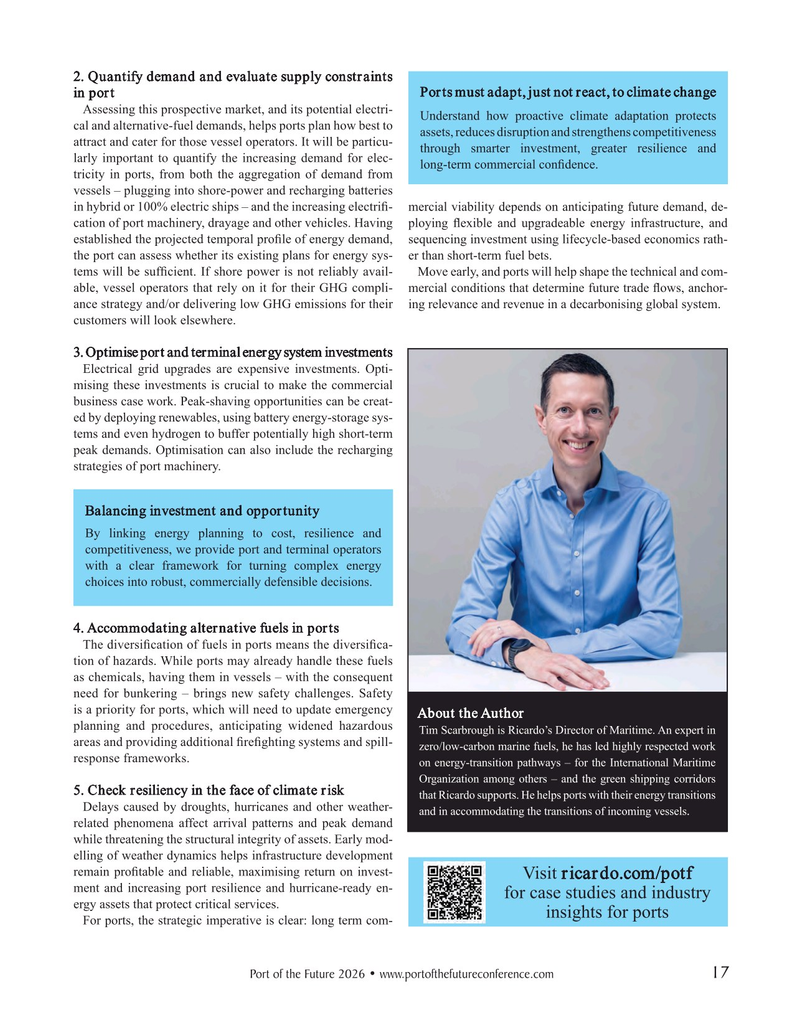
Tim Scarbrough is Ricardo’s Director of Maritime. An expert in areas and providing additional ? re? ghting systems and spill- zero/low-carbon marine fuels, he has led highly respected work response frameworks.
on energy-transition pathways – for the International Maritime
Organization among others – and the green shipping corridors 5. Check resiliency in the face of climate risk that Ricardo supports. He helps ports with their energy transitions
Delays caused by droughts, hurricanes and other weather- .
and in accommodating the transitions of incoming vessels related phenomena affect arrival patterns and peak demand while threatening the structural integrity of assets. Early mod- elling of weather dynamics helps infrastructure development remain pro? table and reliable, maximising return on invest-
Visit ricardo.com/potf ment and increasing port resilience and hurricane-ready en- for case studies and industry ergy assets that protect critical services.
insights for ports
For ports, the strategic imperative is clear: long term com- Port of the Future 2026 • www.portofthefutureconference.com 17 2026_PortoftheFuture_1-17.indd 17 2026_PortoftheFuture_1-17.indd 17 3/3/2026 3:39:07 PM3/3/2026 3:39:07 PM