Page 22: of Maritime Reporter Magazine (February 16, 2026)
Read this page in Pdf, Flash or Html5 edition of February 16, 2026 Maritime Reporter Magazine
 21
21
 23
23
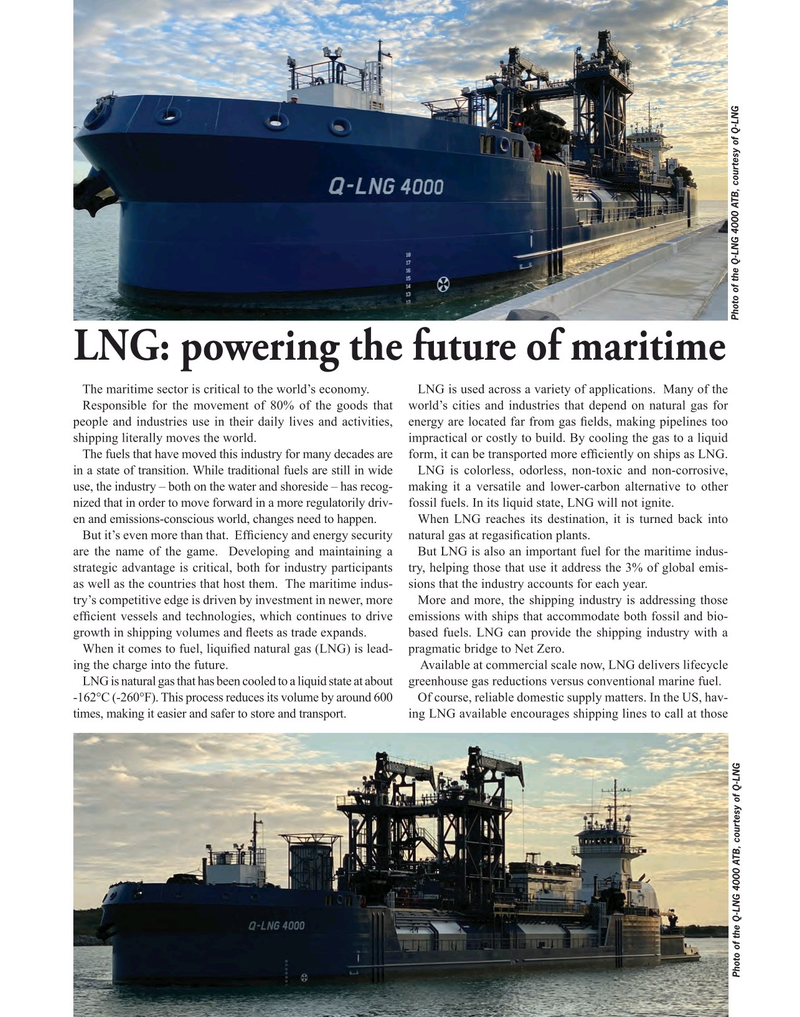
Photo of the Q-LNG 4000 ATB, courtesy of Q-LNG
LNG: powering the future of maritime
The maritime sector is critical to the world’s economy. LNG is used across a variety of applications. Many of the
Responsible for the movement of 80% of the goods that world’s cities and industries that depend on natural gas for people and industries use in their daily lives and activities, energy are located far from gas ? elds, making pipelines too shipping literally moves the world. impractical or costly to build. By cooling the gas to a liquid
The fuels that have moved this industry for many decades are form, it can be transported more ef? ciently on ships as LNG.
in a state of transition. While traditional fuels are still in wide LNG is colorless, odorless, non-toxic and non-corrosive, use, the industry – both on the water and shoreside – has recog- making it a versatile and lower-carbon alternative to other nized that in order to move forward in a more regulatorily driv- fossil fuels. In its liquid state, LNG will not ignite.
en and emissions-conscious world, changes need to happen. When LNG reaches its destination, it is turned back into
But it’s even more than that. Ef? ciency and energy security natural gas at regasi? cation plants.
are the name of the game. Developing and maintaining a But LNG is also an important fuel for the maritime indus- strategic advantage is critical, both for industry participants try, helping those that use it address the 3% of global emis- as well as the countries that host them. The maritime indus- sions that the industry accounts for each year. try’s competitive edge is driven by investment in newer, more More and more, the shipping industry is addressing those ef? cient vessels and technologies, which continues to drive emissions with ships that accommodate both fossil and bio- growth in shipping volumes and ? eets as trade expands. based fuels. LNG can provide the shipping industry with a
When it comes to fuel, liqui? ed natural gas (LNG) is lead- pragmatic bridge to Net Zero.
ing the charge into the future. Available at commercial scale now, LNG delivers lifecycle
LNG is natural gas that has been cooled to a liquid state at about greenhouse gas reductions versus conventional marine fuel. -162°C (-260°F). This process reduces its volume by around 600 Of course, reliable domestic supply matters. In the US, hav- times, making it easier and safer to store and transport. ing LNG available encourages shipping lines to call at those
Photo of the Q-LNG 4000 ATB, courtesy of Q-LNG 2026_PortoftheFuture_18-33.indd 22 2026_PortoftheFuture_18-33.indd 22 3/3/2026 3:46:24 PM3/3/2026 3:46:24 PM