Page 23: of Maritime Reporter Magazine (February 16, 2026)
Read this page in Pdf, Flash or Html5 edition of February 16, 2026 Maritime Reporter Magazine
 22
22
 24
24
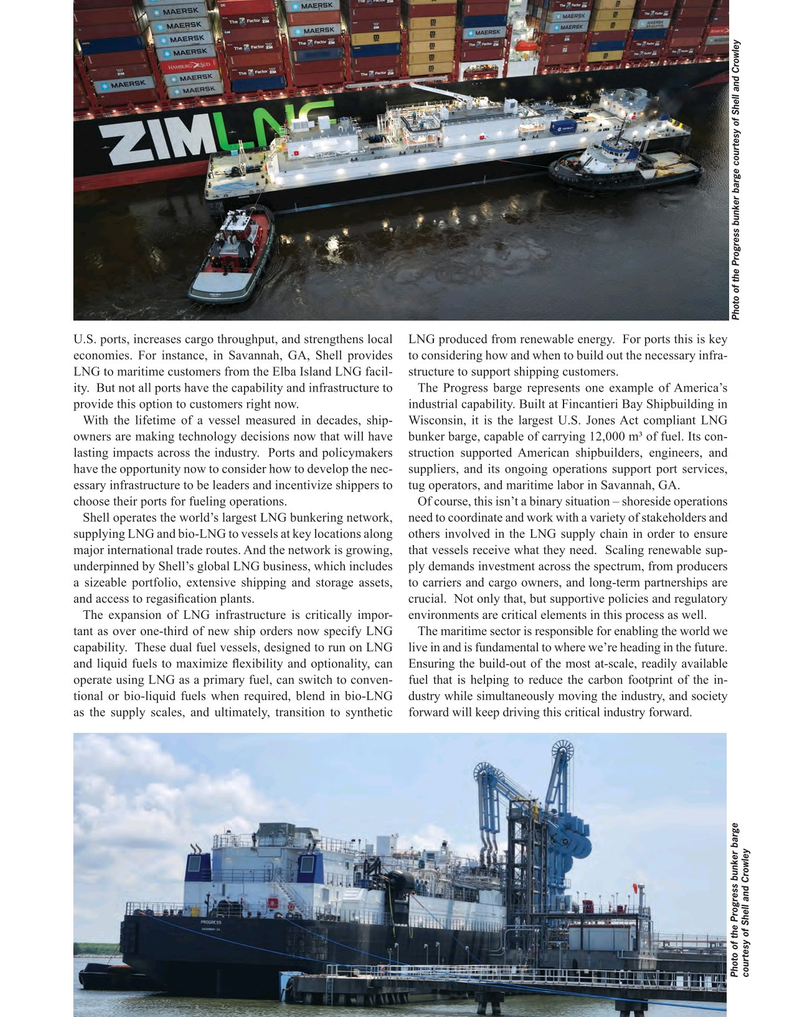
Photo of the Progress bunker barge courtesy of Shell and Crowley
U.S. ports, increases cargo throughput, and strengthens local LNG produced from renewable energy. For ports this is key economies. For instance, in Savannah, GA, Shell provides to considering how and when to build out the necessary infra-
LNG to maritime customers from the Elba Island LNG facil- structure to support shipping customers.
ity. But not all ports have the capability and infrastructure to The Progress barge represents one example of America’s provide this option to customers right now. industrial capability. Built at Fincantieri Bay Shipbuilding in
With the lifetime of a vessel measured in decades, ship- Wisconsin, it is the largest U.S. Jones Act compliant LNG owners are making technology decisions now that will have bunker barge, capable of carrying 12,000 m³ of fuel. Its con- lasting impacts across the industry. Ports and policymakers struction supported American shipbuilders, engineers, and have the opportunity now to consider how to develop the nec- suppliers, and its ongoing operations support port services, essary infrastructure to be leaders and incentivize shippers to tug operators, and maritime labor in Savannah, GA. choose their ports for fueling operations. Of course, this isn’t a binary situation – shoreside operations
Shell operates the world’s largest LNG bunkering network, need to coordinate and work with a variety of stakeholders and supplying LNG and bio-LNG to vessels at key locations along others involved in the LNG supply chain in order to ensure major international trade routes. And the network is growing, that vessels receive what they need. Scaling renewable sup- underpinned by Shell’s global LNG business, which includes ply demands investment across the spectrum, from producers a sizeable portfolio, extensive shipping and storage assets, to carriers and cargo owners, and long-term partnerships are and access to regasi? cation plants. crucial. Not only that, but supportive policies and regulatory
The expansion of LNG infrastructure is critically impor- environments are critical elements in this process as well.
tant as over one-third of new ship orders now specify LNG The maritime sector is responsible for enabling the world we capability. These dual fuel vessels, designed to run on LNG live in and is fundamental to where we’re heading in the future. and liquid fuels to maximize ? exibility and optionality, can Ensuring the build-out of the most at-scale, readily available operate using LNG as a primary fuel, can switch to conven- fuel that is helping to reduce the carbon footprint of the in- tional or bio-liquid fuels when required, blend in bio-LNG dustry while simultaneously moving the industry, and society as the supply scales, and ultimately, transition to synthetic forward will keep driving this critical industry forward.
Photo of the Progress bunker barge courtesy of Shell and Crowley 2026_PortoftheFuture_18-33.indd 23 2026_PortoftheFuture_18-33.indd 23 3/3/2026 3:46:42 PM3/3/2026 3:46:42 PM