
Surface Warfare Center Carderock Division
-
- Control Systems on LCC 20 Saves Fuel, Reduces Workload Maritime Reporter, May 2013 #71
Naval Sea Systems Command completed the installation of new control systems aboard USS Mount Whitney (LCC 20), April 8, which will reduce fuel usage and crew workload.
Engineers from the Naval Surface Warfare Center Carderock Division - Ship Systems Engineering Station (NSWCCD-SSES) SSES installed the new control systems on a number of shipboard engineering components and are specifically designed to improve automation on the optimally manned ships. “Military Sealift Command-operated ships like the Mount Whitney traditionally have lower manning levels, therefore being able to operate many systems from one central control unit is essential,” said Matthew Douglass, Auxiliary Machinery Automation Branch head. “The automation of the controls greatly improves the quality of life for the professional engineers aboard.”
Todd Woltjen, mechanical engineer with Auxiliary Machinery Automation Branch who coordinated and oversaw the upgrades, said the improved automation saves money by reducing fuel consumption and lowering the electricity used.
“For example, upgrading the main engine lube oil pressure system from constant two speed pumps to variable speed drives allows the pumps to throttle at speeds between 10-100 percent,” said Woltjen. “This ability uses less electricity and maintains more stable pressure, which saves money.”
According to Woltjen, limitations in automation when the ship was built did not allow for optimization of the fuel-to-air mixture used in boiler combustion. This caused excess air in the combustion process and resulted in higher fuel consumption.
“With current automation we can accurately measure more processes such as combustible gases,” said Woltjen. “We can integrate data into more powerful [programmable logic controllers] to optimize the fuel/air mixture and reduce excess waste heat up the stack, ultimately using less fuel.”
Mount Whitney’s control systems were upgraded over three weeks from late March to early April during the ship’s availability at the San Giorgio Del Porto shipyard in Genoa, Italy. The Ship Systems Engineering Station, Philadelphia, is a major component of Naval Surface Warfare Center Carderock Division and a field activity of the Naval Sea Systems Command. It is the Navy’s principal test and evaluation station and in-service engineering agent for all hull, mechanical and electrical ship systems and equipment, and has the capability to test and engineer the full range of shipboard systems and equipment from full-scale propulsion systems to digital controls and electric power systems.
(As published in the May 2013 edition of Maritime Reporter & Engineering News - www.marinelink.com)
-
- Propulsion System Demonstrator Powered By GE Gas Turbine Maritime Reporter, May 1992 #62
Assault program. The turbine reportedly was successful in powering the vehicle during waterborne testing. Tests conducted by the Naval Surface Warfare Center, Carderock Division, reportedly proved that an amphibious vehicle can travel at over 20 miles per hour (mph) in the water and also
-
- N a v y Honors Propeller Expert Maritime Reporter, May 2001 #28
27 at the U.S. Navy's Large Cavitation Channel (LCC). This unique engineering test facility will bear the name of the former head of the Naval Surface Warfare Center, Carderock Division's Hydromechanics Directorate who retired in December after 50 years of service to the nation. The facility will be
-
- LCS Hull Concept Tests Move Ahead Maritime Reporter, Nov 2003 #80
series of tank tests that will prove the efficacy of several significant design improvements. The scaled hull model test program underway at the Naval Surface Warfare Center, Carderock Division in Bethesda. MD. will validate the improvements in the resistance, stability and sea keeping characteristics
-
- Navy Tests Scale Models in Big Facilities Marine Technology, May 2018 #28
Inside Naval Surface Warfare Center, Carderock DivisionThe Naval Surface Warfare Center, Carderock Division in West Bethesda, Md., is one of the world’s leading centers for surface and underwater hydrodynamic expertise, research and design, to include world-class facilities for experimentation, testing
-
- A “Look Under the Hood” Maritime Reporter, Sep 2013 #106
Students glimpse the U.S. Navy’s Newest, Hottest Engines On April 25 2013, my family and I went to the Naval Surface Warfare Center, Carderock Division (NSWCCD), Ship Systems Engineering Station (SSES), for national “Take Our Daughters and Sons to Work Day.” Most of the people who work there are engineers
-
- U.S. Navy Keeps Ship-Shape With Software Maritime Reporter, Oct 2000 #76
The Naval Surface Warfare Center uses Adams software to simulate USN ship hull and deck equipment. The technology is used for conceptualization and design-for-manufacturability simulations. As a result, design cycles have been slashed by 50%. Hull and deck machinery equipment — such as watertight
-
- USCG Makes Headway in Challenging Waters Maritime Reporter, Mar 2015 #48
guided missile frigates. As the Perry’s are being decommissioned, engineers at Naval Ship Systems Engineering Station (NAVSSES), Naval Surface Warfare Center Carderock Division are harvesting weapon system components from decommissioned FFGs for re-use on the cutters, with an expected cost avoidance of more
-
 )
June 2024 - Maritime Reporter and Engineering News page: 27
)
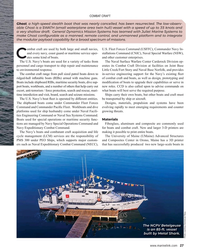
June 2024 - Maritime Reporter and Engineering News page: 27(NSW), Cates some kind of boats. and other customer enterprises. The U.S. Navy’s boats are used for a variety of tasks from The Naval Surface Warfare Center Carderock Division op- personnel and cargo transport to ship repair and maintenance erates its Combat Craft Division at facilities on Joint Base to
-
 )
May 2018 - Marine Technology Reporter page: 30
)
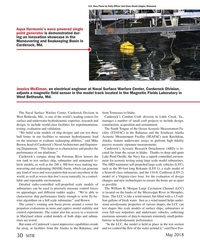
May 2018 - Marine Technology Reporter page: 30demonstrated dur- ing an innovation showcase in the Maneuvering and Seakeeping Basin in Carderock, Md. Jessica McElman, an electrical engineer at Naval Surface Warfare Center, Carderock Division, adjusts a magnetic ? eld sensor in the model track located in the Magnetic Fields Laboratory in West Bethesda
-
 )
November 2004 - Maritime Reporter and Engineering News page: 4
)
November 2004 - Maritime Reporter and Engineering News page: 4Marine 80 Fincantieri 62,70 Mycetx Technologies 71 Xantic 79 Flensburger Schiffbou 62 NASSCO 12 G.R. Bowler 48 Nauticast 80 GE Diesel 40 Naval Surface Warfare Center, Carderock Division 74 General Maritime 63 New Century Shipbuilding 53 Global Industries 30 Nichols Brothers 59 Global Marketing
-
 )
August 2013 - Maritime Reporter and Engineering News page: 88
)
August 2013 - Maritime Reporter and Engineering News page: 88. . . . . . . . . . .(954) 763-3660 67Nabrico Marine Products . . . . . . . . . . . .www.nabrico-marine.com . . . . . . . . . . . . .(615) 442-1300 67Naval Surface Warfare Center, Carderock Division www.fbo.govPlease visit our website 66Niedax Inc. . . . . . . . . . . . . . . . . . . . . . .www.niedaxusa.com
-
 )
May 2013 - Maritime Reporter and Engineering News page: 71
)
May 2013 - Maritime Reporter and Engineering News page: 71the San Giorgio Del Porto shipyard in Genoa, Italy. The Ship Systems Engineering Station, Philadelphia, is a major component of Naval Surface Warfare Center Carderock Division and a Þ eld activity of the Naval Sea Systems Command. It is the Navy?s princi- pal test and evaluation station and in-service
-
 )
June 2, 2010 - Maritime Reporter and Engineering News page: 78
)
June 2, 2010 - Maritime Reporter and Engineering News page: 78, University of Texas-San Antonio, and University of Washington. U.S. Navy Center for Innovation in Ship Design, lo- cated at the Naval Surface Warfare Center Carderock Division, will support the NEEC. The NEEC Consortium will increase the number of students who graduate with an accredited degree; pro- vide
-
 )
February 2013 - Maritime Reporter and Engineering News page: 56
)
February 2013 - Maritime Reporter and Engineering News page: 56. . . . . . . . . . . . . . . . . . . . . . . . . . . . . . . . . . . . . . . . . . . . . . . . . . .(501) 778-4151 39 . . . . . .Naval Surface Warfare Center Carderock Division . . . . . . . . .www.fbo.gov . . . . . . . . . . . . . . . . . . . . . . . . . . . . . . . . . . . . . . . . . . . . . . . .Please
-
 )
October 2011 - Maritime Reporter and Engineering News page: 47
)
October 2011 - Maritime Reporter and Engineering News page: 47was also a teacher training class for local teachers facilitated by Susan Nelson and Toby Ratcliffe, Research Hy- drodynamicist, Naval Surface Warfare Center Carderock Division and Educa- tional Outreach Coordinator, National Defense Education Program (NDEP)Pre-Engineering Program. Teachers all over America
-
 )
March 2008 - Marine Technology Reporter page: 50
)
March 2008 - Marine Technology Reporter page: 50The Advanced Electric Ship Demonstrator (AESD), Sea Jet, undergoes sea trials on Lake Pend Oreille at the Naval Surface Warfare Center Carderock Division, Acoustic Research Detachment in Bayview, Idaho. Funded by the Office of Naval Research (ONR), Sea Jet is a 133-foot vessel testing
-
)
March 2008 - Marine Technology Reporter page: 48
The Advanced Electric Ship Demonstrator (AESD), Sea Jet, undergoes sea trials on Lake Pend Oreille at the Naval Surface Warfare Center Carderock Division, Acoustic Research Detachment in Bayview, Idaho. Funded by the Office of Naval Research (ONR), Sea Jet is a 133-foot vessel testing
-
)
September 2007 - Marine Technology Reporter page: 27
ecosystem research." Henry B. Bigelow was designed in a unique partnership between NOAA's Office of Marine and Aviation Operations and the U.S. Naval Surface Warfare Center, Carderock Division, in Bethesda, Md. The ship was built at VT Halter Marine Inc., in Moss Point, Miss. The vessel is to be commissioned
-
 )
September 2009 - Maritime Reporter and Engineering News page: 41
)
September 2009 - Maritime Reporter and Engineering News page: 41prototype performed just as predicted. From 2000-02, EB did model tests of its early permanent magnet motor rim driven pods at Naval Surface Warfare Center Carderock Division. From 2002-04 EB manufactured its first prototype and began doing in-air tests at the company's manufacturing plant in Quonset Point
-
 )
October 2008 - Marine News page: 48
)
October 2008 - Marine News page: 48RUST NEVER SLEEPS General Dynamics Information Technology, has been awarded three Seaport-e task orders by the Naval Sea Systems Command (NAVSEA) Naval Surface Warfare Center, Carderock Division (NSWCCD), in Philadelphia. The contracts have a total potential value of $26.7 million if all options are exercised
-
)
August 2008 - Maritime Reporter and Engineering News page: 10
April 7, 2008 through July 7, 2009. Alion will analyze the current design of the EFV bow flap, and a new concept developed by the Naval Surface Warfare Center Carderock Division, making any needed modifications to improve structure, reliability and performance. As part of this contract, Alion will design,
-
)
August 2008 - Maritime Reporter and Engineering News page: 8
Test on USS Higgins American Superconductor Corporation has supplied components to the Office of Naval Research (ONR) and the Naval Surface Warfare Center Carderock Division (NSWCCD) Ship Engineering Station Philadelphia for a high temperature superconductor (HTS) degaussing coil system that has successfully
-
)
November 2007 - Maritime Reporter and Engineering News page: 52
for the Exploration of the Sea. Henry B. Bigelow was designed in a partnership between NOAA's Office of Marine and Aviation Operations and the U.S. Naval Surface Warfare Center, Carderock Division, in Bethesda, Md, and was built at VT Halter's Moss Point yard. Artists rendering T-AGM 25 (formerly T-AGM(R)
-
)
January 2007 - Maritime Reporter and Engineering News page: 39
are attractive because they result in much reduced motion when compared to traditional monohulls of the same displacement. However, even catamarans, surface effect ships and SWATHs (small water area twin hull) AMVs are subject to some motion in a seaway, particularly in high sea states. The designer should