
Robert Fulton
-
- Ship Design & The Inevitability of Change Maritime Reporter, Oct 2019 #46
At one time the most powerful lighthouse in the United States was Twin Lights in Highlands New Jersey. Today it is a wonderful little museum and right now it has a very interesting show of paintings by Maarten Platje on the War of 1812. One painting is called the Great Chase and it tells this amazing story of the US Frigate Constitution being becalmed off the New Jersey coast and becoming engaged in a rowing race to keep out of range of a powerful British Squadron. The Constitution escaped and went on to have her amazing victories that year, but if she had been caught, today we would have never heard of her.
What really struck me as interesting is that, while this rowing race was taking place offshore, Robert Fulton was running his steamboat up and down the Hudson not even 100 miles away. If that steamboat had been out there to tow the Constitution, she could have outmaneuvered the entire squadron and really put a hurt on the British, and navy steam would have been adopted overnight.
Instead, we know that steam did not become a feature of naval warfare until the Civil War half a century later.
What is less well known is that during the War of 1812 Robert Fulton built a steam gunboat and even delivered it to the US Navy, but the Navy never quite figured out what to do with it.
Why did it take so long for the technology to be accepted? There are too many reasons for this column to discuss that, but in this 80th anniversary issue of Marine Reporter you are probably reading about things that may appear strange today, but will be commonplace in the 100th anniversary issue. (Maybe I will still write an occasional column at that time and can check back how wrong I was today.)
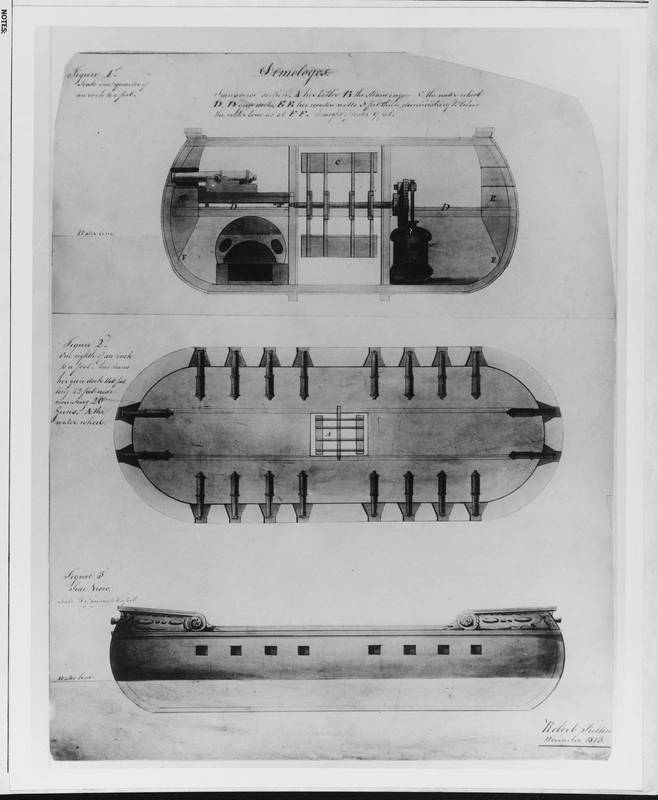 Steam Battery "Demologos" (1814) Drawing by her designer, Robert Fulton, November 1813, showing the ship's general arrangement. Credit: U.S. Naval History and Heritage Command Photograph.
As far as predicting the future is concerned, I am not interested in things that are simply the march of technology like ship autonomy. For my prediction I am reaching back to that painting. I am betting that, in 20 years, commercial sail will have found a new footing in commercial maritime.
I don’t think that sail will become a dominant means of propulsion, but with the pressures of carbon reduction, and a combination of parallel innovations, I am starting to think that there will be a place for commercial sail in long haul bulk transportation.I see quite a lot of sail propulsion proposals out there and, on a technological level, some proposals make sense to me, and others make no sense at all, but what I rarely see is a system analysis of the use of sail in bulk transportation.
The combination of incredibly improved communication methods, vastly better weather and current predictions, and emerging sail technologies, inherently will make sail propulsion much more reliable and will vastly improve the transit times between distant ports over the early 20th century transit times.
The improvement is not just marginal; it is momentous. While I am not for a second suggesting that sailing bulkers will go as fast as today’s fastest sailboats, it should never be forgotten that the fastest waterborne circumnavigations have been achieved with sailboats. Not steamships, not diesel ships, not nuclear ships, not even nuclear submarines; the fastest waterborne circumnavigation was accomplished by the trimaran IDEC 3 in 2017 at 41 days. This boat’s inherent top speed of 33 knots (that is average speed over 24 hours!) was needed, but speed means nothing if you can’t keep the wind, and weather routing allowed this record to be set.
Unfortunately, it is mathematically more difficult to take advantage of weather routing if your vessel is slower (it is more difficult to route the vessel into the optimal winds and to keep it there), but longer term accurate predictions and big oceans with lots of alternatives help a lot.
Today it is not unrealistic to assume an average transit speed of 8-10 knots on long voyages for big sailing bulkers.That is zero emissions at speeds that are not far away from slow steaming bulkers!
Unfortunately, the logistics customer today wants predictability and average speeds are not the same as actual speeds, and therefore the cargo may arrive a little late, or a little early.
There are two ways to fix this issue. One is to generate a little energy underway with solar or trailing propeller systems. This energy can be managed to keep the vessel in the wind zones by running under power for relatively short distances when needed.
The other way to fix it is to think in logistical system terms. If we think of sailing bulkers as both transport and storage devises, a fleet of sailing bulkers can simply be loaded and sent on their way to deliver the cargo at some distant location. Once the flow starts, the vessels can be scheduled to arrive earlier and simply keep station under sail until the berth is available. Two or three vessels in the proverbial pipeline can ensure, to a very high degree of certainty, that cargo will be delivered when required.
Most likely sailing bulkers will use a combination of both approaches and other technological advances that will come down the pike in the next few decades.
I am pretty sure it will happen, unless there is a renewed interest in nuclear propulsion. Newer nuclear technologies show a huge amount of promise, but while an individual shipowner can elect to invest in sail, the investment in nuclear needs to be driven by government investment. And government investment in maritime is as rare as a young nation with a small Navy being able to teach the largest Navy in the world a lesson or two.
The AuthorRik van Hemmen is the President of Martin & Ottaway, a marine consulting firm that specializes in the resolution of technical, operational and financial issues in maritime. By training he is an Aerospace and Ocean engineer and has spent the majority of his career in engineering design and forensic engineering.
This article was first published in the October 2019 edition of Maritime Reporter & Engineering News. For each column I write, Maritime Reporter & Engineering News has agreed to make a small donation to an organization of my choice. For this column I nominate Twin Lights Historical Society, the co-organizer (with NMHA) of Guns Blazing! The War of 1812 exhibit at Twin Lights Museum in Highlands, NJ. The show will run through November 22, 2019. http://www.twinlightslighthouse.com/about-us.html
-
- New England Sections Of ASNE And MTS Discuss Submersibles Maritime Reporter, Dec 15, 1978 #41
was a one-man self-propelled vehicle of the Revolutionary War that traveled just beneath the surface. The forerunner of the modern submarine was Robert Fulton's Nautilus. This vessel of 1800 used a sail for surface propulsion and a hand-driven screw propeller for submerged travel. After highlighting many
-
- 1978 Maritime Day Program In The Port Of New York — New Jersey Maritime Reporter, Jul 1978 #16
in the exciting pageant included symbolic Egyptian, Roman and Viking seamen, as well as Christopher Columbus, Henry Hudson, John Paul Jones, Robert Fulton, the fictional Captain Ahab, and World War II merchant seamen from Britain and the United States. The flag brigade included 100 cadets — 50
-
- The Holland Project: Leveraging History to Build Tomorrow's Ships Maritime Reporter, Nov 2002 #66
, including the ship's dual propulsion system. The idea to use different propulsion systems for surfaced and submerged operations dates back to Robert Fulton, who combined a hand-cranked propeller with a sail that folded for submerged operations. But John Holland was the first to combine an electric
-
- Rebuilding the Presumption of Preemption Maritime Reporter, May 2013 #18
later. The state of New York had granted exclusive rights for the operation of mechanically-powered ships in its waters to the company founded by Robert Fulton. A competing company brought suit. After losing in New York state court, the competitor appealed to the US Supreme Court. In striking down the
-
 )
October 2019 - Maritime Reporter and Engineering News page: 46
)
October 2019 - Maritime Reporter and Engineering News page: 46race was tak- the Civil War half a century later. 100th anniversary issue. (Maybe I will Great Chase and it tells this amazing ing place offshore, Robert Fulton was What is less well known is that during still write an occasional column at that story of the US Frigate running his steamboat the War
-
 )
July 1978 - Maritime Reporter and Engineering News page: 12
)
July 1978 - Maritime Reporter and Engineering News page: 12heroes in the exciting pageant included symbolic Egyptian, Roman and Viking seamen, as well as Christopher Columbus, Henry Hudson, John Paul Jones, Robert Fulton, the fictional Captain Ahab, and World War II merchant seamen from Britain and the United States. A musical salute to "Merchant Marine Heroes
-
 )
July 1974 - Maritime Reporter and Engineering News page: 10
)
July 1974 - Maritime Reporter and Engineering News page: 10Upon conclusion of the midday ceremonies held at Pier 16 at the Seaport, a reception and buffet luncheon was held aboard the Seaport's flagship Robert Fulton. At the luncheon, a special recognition award was presented by the president of the South Street Seaport Mu- seum, Peter Stanford, to George
-
 )
December 1973 - Maritime Reporter and Engineering News page: 44
)
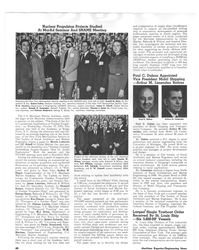
December 1973 - Maritime Reporter and Engineering News page: 44And SNAME Meeting Attending the New York Metropolitan Section meeting at the USMMA were, from left to right: Arnold M. Stein, M. Ro- senblatt & Son; Robert Fulton, Modular Systems, Inc., secretary-treasurer of the New York Metropolitan Section; Capt. W.M. Maclean, Department of Engineering, USMMA, chairman
-
 )
August 15, 1973 - Maritime Reporter and Engineering News page: 2nd Cover
)
August 15, 1973 - Maritime Reporter and Engineering News page: 2nd Coversuccessful diving boat Nautilus and the steamboat Claremont, which navigated the Hudson River between New York City and Albany. Although Robert Fulton is commonly referred to as the inventor of the steamboat, he was instead, the one who devised a practical design for it and demonstrated its
-
 )
June 2006 - Maritime Reporter and Engineering News page: 24
)
June 2006 - Maritime Reporter and Engineering News page: 24("The Marianas Turkey Shoot") June 20, 1813 - Fifteen U.S. gunboats engage 3 British ships in Hampton Roads, VA 1815 - Trials of Fulton I, built by Robert Fulton, are completed in New York. This ship would become the Navy's first steam-driven warship. 1898 - U.S. forces occupied Guam, which became first
-
 )
September 2005 - Maritime Reporter and Engineering News page: 28
)
September 2005 - Maritime Reporter and Engineering News page: 28built the successful barge-hauler, Charlotte Dundas. A great success story of the paddle wheel era were the stern-wheelers invent- ed by American Robert Fulton and which plied the great rivers of North America. Great romance attached to these combinations of transportation, floating hotels and gambling
-
 )
June 1995 - Maritime Reporter and Engineering News page: 11
)
June 1995 - Maritime Reporter and Engineering News page: 11, JET EXPRESS, LINDSEY, VICTORIA CLIPPER III, JET CAT EXPRESS, 0SPREY, HAMPTON, BRICK BAT, JET EXPRESS II, GOLDEN GATE, KEVIN C. KANE, HENRY HUDSON, ROBERT FULTON, GULF CHALLENGER, EMPIRE STATE, KENNY HANSEN, VIZCAYA, FRIENDSHIP IV, GARDEN STATE, WINSTON L. PARRIS, CAPT. WYSS, LAKE CHARLES PILOT, OUTWARD
-
 )
January 1994 - Maritime Reporter and Engineering News page: 29
)
January 1994 - Maritime Reporter and Engineering News page: 29Somerset, Mass. and delivered to New Jersey-based Port Imperial Ferry Company for passenger ser- vice between New Jersey and New York City. Robert Fulton can carry up to 400 passengers, and the vessel's unique bow-unloading system safely offloads 100 passengers per minute. Robert Fulton's
-
 )
January 1994 - Maritime Reporter and Engineering News page: 28
)
January 1994 - Maritime Reporter and Engineering News page: 28Aquamet Coatings Devoe VHF radio Sitex Radar Furuno Compass KVH Fire pumps Crown Bilge pump Flomax Sewage pump Hydromatic Vessel: Robert Fulton Ferry Gladding-Hearn The Robert Fulton is a monohull fast ferry built by Gladding-Hearn Shipbuilding, The Duclos Corp., 30 Circle 255
-
 )
January 1994 - Maritime Reporter and Engineering News page: 26
)
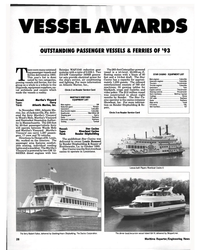
January 1994 - Maritime Reporter and Engineering News page: 26Riverboat Casino II. The dinner boat/excursion vessel Island Girl VI, delivered by SkipperLiner. Maritime Reporter/Engineering News The ferry Robert Fulton, delivered by Gladding-Hearn Shipbuilding, The Duclos Corporation. 28
-
 )
August 1993 - Maritime Reporter and Engineering News page: 60
)
August 1993 - Maritime Reporter and Engineering News page: 60Rector Shipping 7/93 SHIPYARD Vessel Type Dimensions (in feet) L x W x D Main Engines Owner/Operator Delivery Date Henry Hudson Ferry Robert Fulton Ferry Golden Gate Pilot Boat Gulf ChallengerResearch Gulf Craft Inc. 97x24 Caterpillar Port Imperial Ferries 1/93 97x24 Caterpillar Port
-
 )
October 2006 - Maritime Reporter and Engineering News page: 43
)
October 2006 - Maritime Reporter and Engineering News page: 43River near Decatur, Ala. October 29, 1814 - Launching of Fulton I, first American steam powered warship, at New York City. The ship was designed by Robert Fulton. October 30, 1775 - Congress authorizes four vessels for the defense of the United Colonies. 1799 - William Balch becomes Navy's first commissioned