
Panama Canal
-
- Panama Canal: The Billion Dollar Challenge Maritime Reporter, Aug 2014 #12
Panama Canal expansion will cost operators, insurers
As the Panama Canal prepares to celebrate its 100th anniversary, insurers are warning of the increased risks that will arise from the plan to double the cargo-carrying capacity of the world’s most famous canal.
In a report entitled Panama Canal 100: Shipping Safety and Future Risks, Allianz Global Corporate & Specialty (AGCS) identifies that the value of insured goods transiting the canal zone may increase by over $1 billion per day following completion of the Third Set of Locks Project, which will see two new sets of locks built, creating a third transit lane for larger ships.
Today, more than 12,000 ships navigate the canal each year, a number that should increase following the anticipated opening of the new locks in 2015. It is forecast the expansion will enable between 12 and 14 larger vessels per day, or approximately 4,750 additional ships per year, to pass through the canal. Of particular significance is that many of these ships are expected to be new-Panamax class container vessels of 12,600 teu, which are almost three times larger than the existing largest vessels able to access the canal (4,400 teu).
With approximately 3 percent ($270 billion) of world maritime commerce ($9 trillion) already transiting the Panama Canal every year, the safe passage of vessels is critical. However, AGCS warns the increased traffic and larger vessels may challenge the Panama Canal’s improved safety record over the past decade with the risks exacerbated through the initial period of the canal opening.
“Larger ships automatically pose greater risks,” said Captain Rahul Khanna, AGCS’s Global Head of Marine Risk Consulting. “The sheer amount of cargo carried means a serious casualty has the potential to lead to a sizeable loss and greater disruption.”
Post-expansion, if operating at full projected capacity, AGCS estimates that this could result in an additional $1.25 billion in insured goods passing through the canal in one day, with larger ships playing a critical role in increasing throughput capacity.
An additional element to consider, and one that has been at the forefront of many salvage conference agendas for many years as vessels grow increasingly large: such vessels can pose serious salvage challenges in a congested shipping environment, even potentially leading to blockages. In the event of an accident there may be an insufficient number of qualified experienced salvage experts available to handle the ships.
AGCS believes training is key to mitigating the new risks involved, both in the canal region itself and in affected ports. “The expansion of the Panama Canal will represent a new shipping environment for many mariners,” said Captain Khanna. “Due to the increase in the number of larger vessels passing through this important waterway the level of training provided to pilots will be extremely important. Attempting to maneuver one of these vessels through such a restricted space in itself creates a much bigger hazard.” The Panama Canal Authority has invested heavily in training, including plans to charter a post-Panamax ship to practice maneuvers through the new lane.
Losses in Perspective
While the focus is on potential losses, it’s worthy to note that the Panama Canal region has a steadily improving safety record, with only 27 shipping casualties over the past decade and just two total losses. This accident rate of around 1 in every 4000 transits compares favorably with other major waterways such as the Suez Canal (1 in 1100 transits) and the Kiel Canal (1 in 830 transits). As the most frequently transiting types of vessel, bulk carriers (11), cargo ships (9) and container ships (9) dominate the canal’s casualty list, collectively accounting for over 75 percent of all incidents since 2002.
(As published in the August 2014 edition of Maritime Reporter & Engineering News - http://magazines.marinelink.com/Magazines/MaritimeReporter)
-
- Panama Canal: Assessing the Risk & Reward Maritime Reporter, Jul 2016 #18
The Panama Canal’s impact on shipping routes and vessel sizes since it opened in 1914 is undisputed. This will continue with the opening of a third channel for larger vessels in 2016. This briefing examines the risk management impact of this expansion on the maritime industry. Why is the Panama Canal
-
- Maritime History & the Panama Canal Maritime Reporter, Oct 2019 #26
The Panama Canal is a strategic crossroads for maritime traffic, and is arguably one of the most important maritime developments in the past century. Here we take a deeper dive into the history behind that famous strip of waterway.The present canal, which saw its first vessel transits in 1914, along with
-
- Panama Canal Installs Marine Fendering System From Solidur Plastics Maritime Reporter, Mar 1991 #70
Solidur Plastics Co., Delmont, Pa., supplied an Ultra-High Molecular Weight Polyethylene (UHMWPE) marine fender system for the locks at the Panama Canal to protect oceangoing ships from the damaging impacts of bumping into the lockwalls. Jorge Quijano, chief of the Locks Division, Panama Canal
-
- Moss Point Marine Completes Tug For Panama Canal Commission Maritime Reporter, Aug 1986 #50
Moss Point Marine, Inc., Escatawpa, Miss., has completed the all-steel, 105-foot harbor tug, Paz, to the Panama Canal Commission, Republic of Panama. Original construction was begun by another shipyard which did not complete the vessel due to inclement weather and a decision by its management to
-
- NABRICO Constructs 2 Dump Scows For Panama Canal Commission Maritime Reporter, May 1986 #63
. The two 1,300-cubic-yard barges, the first to be built by NABRICO for the Commission, will be used in the on-going dredging operations in the Panama Canal. Each is classed by the American Bureau of Shipping as an unmanned ocean service barge complete with loadline. A steel reinforced four-inch
-
- Tracor Hydronautics Delivers Part Task Ship-Handling Simulator To Panama Canal Commission Maritime Reporter, Dec 1984 #46
. The simulator is now located in Balboa, Republic of Panama. It will be used as part of an overall program in the training of pilots for the Panama Canal in ship handling. The simulator was purchased from Tracor Hydronautics as a result of a competitive procurement based on specifications and
-
- Eastern Marine Delivers Passenger Launch P.C.C. Colibri To Panama Canal Commission Maritime Reporter, Aug 1984 #10
Eastern Marine, Inc. of Panama City, Fla., recently delivered the 64-foot aluminum passenger launch P.C.C. Colibri (shown above) to the Panama Canal Commission Agency of the U.S. Government. The vessel has a beam of 18 feet and a depth of 8 feet 6 inches. Propulsion equipment on the P.C
-
- Marco Delivers 38-Foot Skimmer To Panama Canal Maritime Reporter, Jun 1983 #14
A second Marco Class 1-D oil skimmer was delivered recently to the Panama Canal Commission. The 38-foot skimmer features Marco's Filterbelt, the key component of all Marco skimmer systems. The Filterbelt separates oil and debris from the water without taking the water aboard. The system has the
-
- SJS Selected To Build Panama Canal Tugs Maritime Reporter, Jan 2001 #55
Saint John Shipbuilding was awarded the contract to supply two new 4,000 hp tugs with an option on two others. The tugs will be built in Georgetown; Prince Edwards Island at East Isle Shipyard under the supervision of Bill Hind. Timberland Equipment will be supplying the deck equipment to East Isle
-
- Dravo SteelShip Delivers Pilot Boats For Panama Canal Maritime Reporter, Nov 15, 1980 #12
Dravo SteelShip Corporation has announced the recent completion and delivery of nine 48-foot pilot boats for the Panama Canal Commission. The single-screw pilot launches have all been delivered to the Canal Zone under their own power. They were delivered two at a time for safety measures. The 2
-
- Thunderbolt Marine Industries Launches Twin 96-Foot Tugs For Panama Canal Services Maritime Reporter, Jul 15, 1977 #17
, Thunderbolt, Ga. They are the first of a new generation of shiphandling and firefighting tugs specifically designed for work in the Panama Canal. The main feature of these tugboats is the capability of the propellers, located just forward of amidship, to be rotated 360 degrees, enabling the
-
 )
May 2026 - Marine News page: 8
)
May 2026 - Marine News page: 8. ports – a waiver already Panama-? agged vessels in an escalation of ongoing dis- unprecedented in both length and scope and recently putes over the Panama Canal; and beyond. extended for an additional 90 days from the May 17 By contrast, the American tugboat, towboat and barge expiration date – has had
-
 )
March 2026 - Marine News page: 20
)
March 2026 - Marine News page: 20Learned So where are the “lessons learned” as it relates to U.S. commercial shipbuilding. Worldwide geopolitical events in Venezuela, Suez, and the Panama Canal coupled with a sanctioned Russian ghost ? eet have created more than elevated interest in the North- ern Sea Route along Russia’s Arctic coast
-
 )
September 2024 - Maritime Reporter and Engineering News page: 10
)
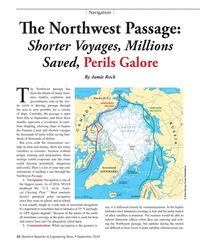
September 2024 - Maritime Reporter and Engineering News page: 10, the passage is open from July to September, and those three months represent a revolution in mari- time shipping, allowing ships to bypass the Panama Canal and shorten voyages by thousands of miles while saving hun- dreds of thousands of dollars. But even with the tremendous sav- ings in time and money
-
 )
August 2024 - Maritime Reporter and Engineering News page: 52
)
August 2024 - Maritime Reporter and Engineering News page: 52attacking ships at will in the Red Sea and a prolonged discussing the maritime fuel transition, digitalization and auto- low-water situation at the Panama Canal, two major mation in the name of ef? ciency, Rolner admits the ef? ciencies shortcuts have been eliminated and/or minimized. “We his company
-
 )
June 2024 - Maritime Reporter and Engineering News page: 17
)
June 2024 - Maritime Reporter and Engineering News page: 17possibility. Reports of The disruption in the Red Sea, combined with factors linked vessels experiencing GPS interference and jamming, which to the Panama Canal and the Black Sea in the wake of the can result in lost or inaccurate signals affecting navigation Ukraine war, could erode the environmental
-
 )
May 2024 - Maritime Reporter and Engineering News page: 30
)
May 2024 - Maritime Reporter and Engineering News page: 30see the ing ? eld, but it doesn’t exist. We want to assist on the imple- mentation of our regulations for everyone to enhance safety, ships in the Panama Canal. That connection with the Panama Canal is when it started to become attractive for me, and security, protection of the environment, etc. One of
-
 )
April 2024 - Marine News page: 33
)
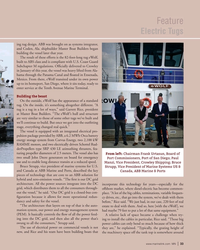
April 2024 - Marine News page: 33Coast Guard Subchapter M regulations. Of? cially delivered to Crowley in January of this year, the vessel was heavy lifted from Ala- bama through the Panama Canal and ? oated in Ensenada, Mexico. From there, eWolf transited under its own power up to its homeport, San Diego, where it sits today, ready to
-
 )
November 2023 - Marine News page: 30
)
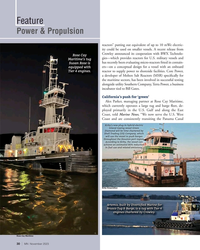
November 2023 - Marine News page: 30primarily in the U.S. Gulf and along the East Coast, told Marine News, “We now serve the U.S. West Coast and are consistently transiting the Panama Canal Kirby’s new plug-in hybrid electric inland towing vessel Green Diamond will be time chartered by Shell Trading (US) Company, which will use
-
 )
September 2023 - Maritime Reporter and Engineering News page: 45
)
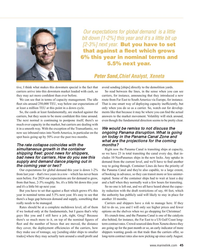
September 2023 - Maritime Reporter and Engineering News page: 45be remiss to not discuss the ongoing Panama disruption. What is going now see inbound rates into North America, in particular on the on today in the Panama Canal Zone and spot basis going up by 50% over the past two months. what are the projections for the coming The rate collapse coincides with the months
-
 )
October 2022 - Marine News page: 19
)
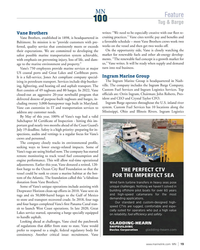
October 2022 - Marine News page: 19and six 50,000-barrel barges to the Gulf of Mexico to store and transport recovered crude. In 2018, four tugs and four barges completed Vane’s ? rst Panama Canal tran- sit to launch West Coast operations. In late 2020, Great Lakes service started, operating a barge specially equipped to handle asphalt. Looking
-
 )
February 2022 - Maritime Reporter and Engineering News page: 57
)
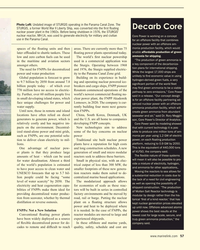
February 2022 - Maritime Reporter and Engineering News page: 57Photo Left: Undated image of STURGIS operating in the Panama Canal Zone. The Decarb Core STURGIS, a former World War II Liberty Ship, was converted into the ? rst ? oating nuclear power plant in the 1960s. Before being shutdown in 1976, the STURGIS’ nuclear reactor, MH-1A, was used to generate electricity
-
 )
December 2021 - Maritime Reporter and Engineering News page: 12
)
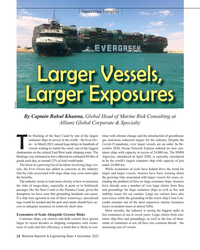
December 2021 - Maritime Reporter and Engineering News page: 12of mega-ships, especially in ports or in bottleneck have already seen a number of very large claims from ? res passages like the Suez Canal or the Panama Canal, given the and groundings for large container ships as well as ? re and disruption we have seen that grounding incidents can cause. stability
-
 )
May 2021 - Marine News page: 3rd Cover
)
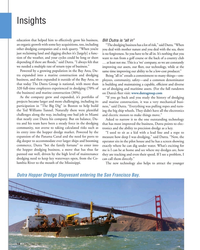
May 2021 - Marine News page: 3rd Coverdredge as a key. its entry into the hopper dredge market. Powered by the “I used to sit as a kid with a lead line and a rope to expansion of the Panama Canal and the need for ports to measure how deep I was dredging,” said Dutra. “Now, the dig deeper to accommodate ever larger ships and booming operator
-
 )
June 2021 - Marine News page: 23
)
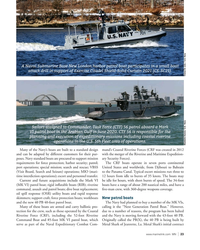
June 2021 - Marine News page: 23mission; search and rescue; VBSS United States and worldwide, from Djibouti to Bahrain (Visit Board, Search and Seizure) operations; MIO (mari- to the Panama Canal. Typical escort missions run three to time interdiction operations); escort and personnel transfer. 12 hours from idle to bursts of 35 knots.
-
 )
March 2020 - Maritime Reporter and Engineering News page: 25
)
March 2020 - Maritime Reporter and Engineering News page: 25to take advantage of the expanded opening new markets worldwide. Com- channel and service larger, more ef? cient ships, they need to bined with the Panama Canal expansion that determine the serviceability of their facilities. These larger T opened in 2016, the reasons are clear why ships typically require
-
 )
March 2020 - Maritime Reporter and Engineering News page: 20
)
March 2020 - Maritime Reporter and Engineering News page: 20, Baltimore, Houston, Port Everglades and Norfolk. to 50 feet. All these projects funded by Congress draw a direct correla- tion to the expanded Panama Canal. The newly expanded The Port of Baltimore, Maryland Panama Canal now allows ships three times the size of what The U.S. Army Corps of Engineers
-
 )
Nov/Dec 2019 - Maritime Logistics Professional page: 54
)
Nov/Dec 2019 - Maritime Logistics Professional page: 54Industries www.superior-ind.com (320) 589-2406 THE LIST People & Companies in This Edition ABC GreenSteam ................................ 19 Panama Canal ............................. 49 ABS ....... 36, 37, 38, 39, 50, 51, 52 Hall, Stuart ........................... 40, 42 Petrobras .........
-
 )
Nov/Dec 2019 - Maritime Logistics Professional page: 49
)
Nov/Dec 2019 - Maritime Logistics Professional page: 49similar 8.0% decline in Octo- clude population dispersion and ber. Both of these sharp declines are a direct result of the China the expansion of the Panama Canal. tariffs. The table below recaps the inbound TEU volume at the In the latest month, 53.1% of inbound containers at the Top 10 Top 10 U.S. ports
-
 )
October 2019 - Maritime Reporter and Engineering News page: 33
)
October 2019 - Maritime Reporter and Engineering News page: 33HISTORY THE PANAMA CANAL fuel costs due to IMO2020 could prompt (as termed by the eminent geography be 400,000 TEUs in 2014. bound from the Gulf of Mexico to the 1.2 million TEUs inbound to the U.S. professor Jean-Paul Rodrigue) as a link Panama Canal Authority, now deriv- U.S. West Coast. to
-
 )
October 2019 - Maritime Reporter and Engineering News page: 31
)
October 2019 - Maritime Reporter and Engineering News page: 31HISTORY THE PANAMA CANAL early 2016. By 2019, multiple export travelling in ballast…” typically after (which began in late 2015); these move shipping, has the potential to bring about facilities had already come online, with discharging on the U.S. West Coast and on Very Large Crude Carriers (VLCCs)
-
 )
October 2019 - Maritime Reporter and Engineering News page: 30
)
October 2019 - Maritime Reporter and Engineering News page: 30HISTORY THE PANAMA CANAL IMO2020, impacting all aspects of shipping, has the po- tential to bring about a backslide in the East Coast’s traf? c gains. Joshua Hurwitz, Senior Consultant at port designer ? rm Moffaft & Nichol has made the case that in- creased fuel costs due to IMO2020 could prompt 1.
-
 )
October 2019 - Maritime Reporter and Engineering News page: 29
)
October 2019 - Maritime Reporter and Engineering News page: 29HISTORY THE PANAMA CANAL in the event of military activity, drove an ef- lantic. Transits by other well known, but long to be the ? rst ship through the widened canal, fort at Canal expansion, in the early 1940s, gone, U.S. carriers including Grace Line, sailing westwards. Five days later, in the
-
 )
October 2019 - Maritime Reporter and Engineering News page: 28
)
October 2019 - Maritime Reporter and Engineering News page: 28HISTORY THE PANAMA CANAL 28 Maritime Reporter & Engineering News • OCTOBER 2019 MR #10 (26-33).indd 28 10/7/2019 11:57:41 AM
-
 )
October 2019 - Maritime Reporter and Engineering News page: 27
)
October 2019 - Maritime Reporter and Engineering News page: 27HISTORY THE PANAMA CANAL Panama Canal The Panama Canal is a strategic crossroads for maritime traf? c, and is arguably one of the most important maritime developments in the past century. Here we take a deeper dive into the history behind that famous strip of wateray. By Barry Parker he present canal