
Parana
-
- Tech File: Vesconite Rudder Bushings Marine News, Nov 2016 #84
South American river tugboats need robust rudder bushings: some 20 tug boats on the Parana River, running through Brazil, Paraguay and Argentina, have been equipped with Vesconite rudder bushings.
In the challenging waters of South American rivers, tugboat owners began ordering Vesconite’s proprietary thermoplastic rudder bushings starting in 2014. Convinced that the material – which is wear resistant, self-lubricating, environmentally-friendly, requires no grease, and easy to machine and fit – was more suitable than the bronze that has traditionally been used in the application, many firms have permanently made the change. Today, that move is paying dividends.These companies include large South American mining and agriculture companies, which own their own barges and transport their own cargo. “The Parana River is one of the large water highways in South America,” Leandro Panzini of VesArg, the Argentinian distributor of Vesconite products told Marine News last month. He adds, “Towboats push barges on the inland waterway, which can be tough and abrasive on boats.”Vesconite and Panzini both hope that there will be a significant rudder bushings market in the area in the near future, as many fleets upgrade their equipment. Already, though, local South American customers include prominent local operators such as Interbarge, Ultrapetrol, Lógico Paraguay (a Louis Dreyfus division), Cargill and Naviera Chaco (an ADM division).It is a particularly important market for VesArg since river waterways are important arteries via which large cities in South America are linked together and each of these towboats could have four, six or eight rudders and two, three or four propellers. Having introduced the rudder bushings to tug boat owners on the Parana River, the intention is to introduce the product to operators on the waterway in Colombia. “We are currently testing the product in Colombia, which has a smaller water highway and usually has smaller boats operating on it,” said Panzini, adding, “We also intend to introduce Vesconite propeller shaft bushings to the South American river-transport market.”Difficult Conditions, Appropriate SolutionsThe South American rivers in which the tugboats operate tend to be wide and deep, and not dissimilar to the Mississippi River in the United States. The rivers also tend to have significant quantities of suspended debris and sand, which makes the water highly abrasive, and results in rudder bushings having to be replaced more frequently than they would be on traditional boats. “This set of conditions makes Vesconite bushings particularly attractive, since they are exceptionally hard wearing,” says Panzini.The Colombian waterway in which the bushings are being tested currently tend to be even more abrasive than the Parana River, and successful testing of the bushings on this River will, says Panzini, demonstrate that Vesconite is able to cope in the most uncompromising of environments.Vesconite Rudder BearingsVesconite is an internally-lubricated bearing material that is environmentally friendly. It is designed for low wear and minimal maintenance. It is also dimensionally stable, with negligible water swell and a low thermal expansion rate, and carries loads of up to 30MPa. Vesconite has obtained approvals from ABS, Biro Klasifikasi Indonesia, Bureau Veritas, China Classification Society, China Corporation Register of Shipping, DNV GL, the Korean Register of Shipping, Lloyd’s Register, Nippon Kaiji Kyokai, and RINA.Vesconite Bearings, the maker of Vesconite, has warehouses in Johannesburg, Texas, the UK, the Netherlands and New Zealand, with stocking distributors in Australia, Singapore and Argentina. Vesconite rudder bearings are in use globally in a range of rudder types and configurations, including upper and lower pintle bushes, steerable propellers, flap rudders, efficiency rudders and space rudders. In particular, Argentina is proving to be a significant market for the company’s marine products.(As published in the November 2016 edition of Marine News) -
- MacGregor To Equip 30 Barges, 3 Ships Building In Japan For Paraguay Maritime Reporter, Jan 15, 1983 #22
. Land-locked Paraguay is dependent dependent on barge traffic for its commerce. Access to the sea is near Buenos Aires, Argentina, via the Parana and Uruguay Rivers on which the new barges will carry grain, soya bean, cement, and other bulk cargoes. All the vessels — barges and cargo ships
-
- New Luxury Hotel Barge Begins Thames Cruises Maritime Reporter, Jul 15, 1977 #43
the traditional working barge motif of roses, diamonds and castles — an essentially English folk art. Her interior, of hand-rubbed teak, redwood and parana pine, reflects a standard of old-world craftsmanship rarely seen today. Guests eat all but three meals onboard; on three evenings they go ashore
-
- Push Boats: From Turkey to Brazil Maritime Reporter, Mar 2015 #62
and low fuel consumption. The vessels will be used for inland waterways logistics from Colombia in Brazil to Argentina and/or Uruguay through the Paraguay-Parana waterway. The total distance is over 2500 km, much of it navigating through extremely curvy river sections which make excellent maneuverability a
-
- Winch Safety through Standardization Marine News, Jul 2014 #47
branching out into South America over the past six years—and business is booming. “Combined revenues from the three primary markets in South America (the Parana-Paraguay Hidrovia, the Amazon, and the Magdalena) have increased every year since we first entered these markets, and we expect this to continue,”
-
- AET Grows in Brazil Maritime Reporter, Nov 2018 #60
DPST fleet to seven vessels, which places the company in the top three DPST operators in Brazil. Currently, AET operates two 105,153 dwt DPSTs, Eagle Parana and Eagle Paraiba in Brazil. These were delivered as newbuilds in 2012 and have been operating in Brazil since delivery. The four further specialist
-
- SHORTSEA CRANE OPERATIONS: Lifting a Port to Prosperity Marine News, Jun 2019 #42
, Liebherr also supplies their lifting equipment to port interests on inland waterways such as the Amazonas in Brazil, and the River Magdalena and River Parana in Columbia.Nearer to home, and as US inland rivers – from St. Louis all the way to New Orleans – heat up for ‘container-on-barge’ shortsea service
-
- Wilson Sons: Inside Brazil’s Workboat Goliath Maritime Reporter, Nov 2020 #36
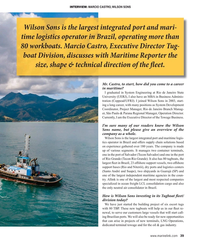
2003, starting a long career, with many positions as System Development Coordinator, Project Manager, Rio de Janeiro Branch Manager, São Paulo & Parana Regional Manager, Operation Director. Currently, I am the Executive Director of the Towage Business.I’m sure many of our readers know the Wilson
-
 )
November 2020 - Maritime Reporter and Engineering News page: 39
)
November 2020 - Maritime Reporter and Engineering News page: 39in 2003, start- ing a long career, with many positions as System Development Coordinator, Project Manager, Rio de Janeiro Branch Manag- er, São Paulo & Parana Regional Manager, Operation Director. Currently, I am the Executive Director of the Towage Business. I’m sure many of our readers know the Wilson
-
 )
November 2018 - Maritime Reporter and Engineering News page: 98
)
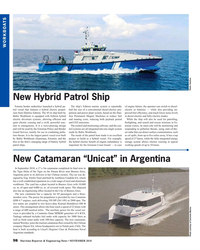
November 2018 - Maritime Reporter and Engineering News page: 9810 knots. New Catamaran “Unicat” in Argentina In September 2018, a 17 x 5m catamaran completed its ? nal tests in the Tigre Delta of the Tigre on the Parana River near Buenos Aires, Argentina prior to its delivery to her Chilean owners. The cat was de- signed by Eng. Emilio Noel and built by Astilleros
-
 )
November 2018 - Maritime Reporter and Engineering News page: 62
)
November 2018 - Maritime Reporter and Engineering News page: 62AET invests heavily in crew manage- as one of the world’s foremost areas for to AET in 2004, expanding the AET ? eet two 105,153 dwt DPSTs, Eagle Parana ment and training, including the training DPST operations, alongside the North/ to more than 50 vessels. The company and Eagle Paraiba in Brazil
-
 )
November 2016 - Marine News page: 84
)
November 2016 - Marine News page: 84ech file T South American River Tugboats Need Robust Rudder Bushings Some 20 tug boats on the Parana River, running through Brazil, Paraguay and Argentina, have been equipped with Vesconite rudder bushings. n the challenging waters of South American rivers, tug- Paraguay (a Louis Dreyfus division),
-
 )
January 2016 - Marine News page: 47
)
January 2016 - Marine News page: 47and River Shipowners (CAFyM) in Asuncion, Paraguay for simulation solutions, well-known VTMS and coastal sur- training crews in tugs operations in the Parana-Paraguay veillance systems, ? eet management systems, onboard and Waterway. Transas provided these capabilities in accordance individual decision
-
 )
March 2015 - Maritime Reporter and Engineering News page: 62
)
March 2015 - Maritime Reporter and Engineering News page: 62Argentina and/or Uruguay through m draft at the wet season, with a 7200 shallow draft operation. The major elec- South America continues to the Paraguay-Parana waterway. The bHP diesel-electric HFO powered push- tric components (AFE drives, propulsion strengthen, powered by orders total distance is over
-
 )
July 2014 - Marine News page: 50
)
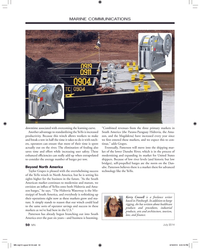
July 2014 - Marine News page: 50out into South America over the past six yearsÑand business is booming. ÒCombined revenues from the three primary markets in South America (the Parana-Paraguay Hidrovia, the Ama- zon, and the Magdalena) have increased every year since we Þ rst entered these markets, and we expect this to con- tinue
-
 )
January 15, 1983 - Maritime Reporter and Engineering News page: 20
)
January 15, 1983 - Maritime Reporter and Engineering News page: 20and Mitsui. Land-locked Paraguay is de- pendent on barge traffic for its commerce. Access to the sea is near Buenos Aires, Argentina, via the Parana and Uruguay Riv- ers on which the new barges will carry grain, soya bean, cement, and other bulk cargoes. All the vessels — barges and cargo
-
 )
November 1997 - Maritime Reporter and Engineering News page: 60
)
November 1997 - Maritime Reporter and Engineering News page: 60Halter Delivers Towboat To Stewart & Stevenson Newly-constructed towboat Captain Bilbo recently commenced service along the Paraguay, Parana, Uruguay and Alto Paran rivers and waterways. Built by Halter Marine for Stewart & Stevenson Services, Inc., the 112 x 32 x 10.6-ft. (34.1
-
 )
October 1999 - Maritime Reporter and Engineering News page: 34
)
October 1999 - Maritime Reporter and Engineering News page: 34Training Is it real or is it... A comparison of the original photography of a spot on the Parana River to the simulation reveals the accuracy of the simulation. The simulation is not at quite the same point on the river, but it's close. Different data as to the time of day and level of the river has
-
 )
October 1999 - Maritime Reporter and Engineering News page: 33
)
October 1999 - Maritime Reporter and Engineering News page: 33river stages and flow condi- tions, etc. In the South American project, one of the earliest sources of such data was Brian Donohue's trip down the Parana. Donohue, who directed design of the simulator's databases, boated down the river for two weeks, videofilming and recording digital stills
-
 )
October 1999 - Maritime Reporter and Engineering News page: 32
)
October 1999 - Maritime Reporter and Engineering News page: 32around the world. For more information, call Red land Genstarat(4l0) 683-9254. Redland GENSTAE Training as a towboat is advancing along the Parana or Paraguay River. A control panel is present, and the simulation sequence changes, based on the decisions the mariner makes as he manipulates
-
 )
October 1999 - Maritime Reporter and Engineering News page: 31
)
October 1999 - Maritime Reporter and Engineering News page: 31CME Creates Computer Simulations of Remote Waterways A barge transporting a large quantity of petroleum moves slowly down the middle of the Parana River in South America. Though it is early evening, the pilot is enclosed in torrid heat, fetid smells from the jungle's rotting vegeta- tion
-
 )
October 1999 - Maritime Reporter and Engineering News page: 2
)
October 1999 - Maritime Reporter and Engineering News page: 2for Maritime Education, situated in America's heartland, is helping to train South American river pilots to safely and efficiently navigate the Parana River. 40 VERA! The Propulsion Performance Products report starts with a story of an innovative vessel under construction at Bollinger for
-
 )
June 1999 - Maritime Reporter and Engineering News page: 42
)
June 1999 - Maritime Reporter and Engineering News page: 42Mar, the Papu Sur will broaden the feeder service's daily sail- ings between Montevideo, Buenos Aires, Asuncion and other ports situated along the Parana, Paraguay and Uruguay river system. Four flat-deck ocean and river barges are also part of the new group of Sur vessels. Measuring 112 ft. (34
-
 )
February 1996 - Maritime Reporter and Engineering News page: 20
)
February 1996 - Maritime Reporter and Engineering News page: 20197 on Reader Service Card ACBL Expands In South America American Commercial Barge Line Co. (ACBL) has launched a service along the Paraguai- Parana River to transport iron ore from Corumba, Brazil to San Nicolas, Argentina. ACBL has contracted with Siderar, an Argentine steel mill, to transport
-
 )
December 1994 - Maritime Reporter and Engineering News page: 10
)
December 1994 - Maritime Reporter and Engineering News page: 10in 1956 as the Missouri and is powered by four EMD12- 645E2 diesels. The vessel will be shipped from New Orleans to South America for service on the Parana and Plate Rivers, pushing iron ore barges. Marcon International, Inc. of Coupeville, Wash, acted as broker in the sale of the pushboat. RTZ
-
 )
June 1993 - Maritime Reporter and Engineering News page: 57
)
June 1993 - Maritime Reporter and Engineering News page: 579,762/18,797 Nor. '68 Esso S.A. Petrolera Argentina Esso Bahia Blanca Tanker 12,806/22,504 Lib. '74 Esso Formosa Tanker 1,944/4,720 Arg. 70 Esso Parana Tanker 1,007/2,470 Arg. '60 Esso Rio Grande Tanker 11,503/16,662 -Lib. '82 Esso Rio Negro Tanker 19,568/38,568 Lib. '75 Esso San Lorenzo Tanker
-
 )
June 1992 - Maritime Reporter and Engineering News page: 123
)
June 1992 - Maritime Reporter and Engineering News page: 123Reader Service Card Successful Brazilian Waterways Project Would Cut Transportation Costs If successful, a plan that would make the Paraguay and Parana river system navigable by barges could reduce Brazilian farm com- modity freight rates by 75 percent, according to David Atkinson, In- ter-American
-
 )
June 1989 - Maritime Reporter and Engineering News page: 73
)
June 1989 - Maritime Reporter and Engineering News page: 73,429 U.K. 8 92,010 167,098 ESSO BAHIA BLANCA Tanker Japan 1974 12,806 22,861 Argentina ESSO FORMOSA Tanker Argentina 1970 1,944 4,684 Argentina ESSO PARANA Tanker Argentina 1960 1,007 2,568 Argentina ESSO RIO GRANDE Tanker Argentina 1982 11,503 15,450 Argentina ESSO RIO NEGRO Tanker Japan 1975 19,568