
Ted Morley
-
- Profiles in Training: Capt. Ted Morley, MPT Maritime Reporter, May 2020 #16
Captain Ted Morley is a ubiquitous figure in maritime training circles, the COO and Academic Principal at MPT in Fort Lauderdales. MPT consistently enrolls more than 10,000 students annually, catering to the whole maritime market from super yachts to super tankers and everything in between. He shares his insights on how the current pandemic is changing maritime training, now and in the future.
How have you altered your operations due to the pandemic?
Even before COVID-19 we designed our main campus to fight viruses and improve air quality. We have UV sterilizers in our AC system and hospital grade hepa filtration, along with hydroxyl units and disinfectant fogging systems. We also pre-filter and pre-condition all the air coming into the building. Currently we are expanding our online portal to include virtual classrooms and more distance learning options.
Had you previously offered distance learning alternatives?
The USCG and other regulators have very strict guidelines on what courses be delivered online. STCW, by its very nature, requires hands on learning and assessments but we are all learning and adapting.
How do you think this pandemic will impact the way in which maritime training and education is delivered in the future?
Long term I see a blended approach to learning. It is difficult to self-study with many of the more technical courses and the hands-on portions will always require a “bricks and mortar” facility.
Which technologies do you view as most promising to deliver maritime training more effectively and efficiently?
Video conferencing and virtual simulations will play a larger role. Efficient yet safe classrooms are a must. The level of technology and infrastructure to effectively deliver and measure the students’ knowledge, understanding, and competence levels will continue to rise. The blended approach will allow students to receive the classroom material early, review and develop a baseline, complete pre-entry familiarization, and then be ready to shift to a classroom setting to complete the learning process and the assessment criteria as established by the STCW Code and the various regulatory agencies. -
- At MPT, Training is Personal Maritime Reporter, Jun 2017 #52
Step into MPT’s new state-of-the-art S.M.A.R.T. simulation center in Fort Lauderdale and Captain Ted Morley lights up. While the center is packed with the very latest in maritime simulation software and hardware, his eagerness to usher us through the new building transcends any new technology, because at
-
- Experts Weigh Training Factor into Sewol Tragedy Maritime Reporter, May 2014 #26
visibility? Resting perhaps?” “Human error seems to be the catch phrase used when no other explanation is immediately forthcoming,” said Captain Ted Morley, COO, MPT. “While it is true that it is very often the underlying cause of an accident, it is important to put it into context and determine what
-
- Performance-Based Assessments Maritime Logistics Professional, Q3 2013 #44
, its clients come from every sector. As ample testament to the diversity and flexibility in its training programs, that client split, says Captain Ted Morley, MPT’s Chief Operations Officer, comes with parity in numbers between the deep sea industries and the near shore or inland industries. As maritime
-
- Simulation: Maritime Professional Training Maritime Reporter, Mar 2017 #58
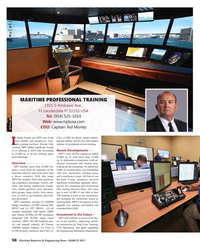
Maritime Professional Training 1915 S Andrews Ave., Ft Lauderdale FL 33316 USA Tel: (954) 525-1014 Web: www.mptusa.com COO: Captain Ted Morley In South Florida sits MPT, one of the most prolific and progressive maritime training facilities. Already fully stocked, MPT added significant
-
- Maritime Simulation: High-tech Meets Practical Skills Maritime Reporter, Mar 2018 #57
Training (MPT). “The oil and gas market slowdown has definitely been felt by the mariners, industry, and training providers alike,” said Captain Ted Morley, Chief Operations Officer, Academic Principal, MPT. Tangibly MPT felt the pinch in student flow, with just more than 14,000 students coming through
-
- Maritime Training amid COVID-19 Marine News, Jul 2020 #26
be delivered online. STCW, by its very nature, requires hands-on learning and assessments but we are all learning and adapting,” notes Captain Ted Morley, COO and academic principal at Maritime Professional Training (MPT) in Fort Lauderdale, Fla.“Even before COVID-19 we designed our main campus
-
- Marine Firefighting at Sea: Training to Survive Maritime Reporter, Oct 2015 #28
importance on fire fighting training, an over-reliance on fixed suppression systems can be dangerous and create a sense of false security,” said Capt. Ted Morley, Master Unlimited, AFNI, Chief Operations Officer, Maritime Professional Training (MPT). “Having well trained first responders is vital as they can
-
- Simulating the Next Big Thing Maritime Logistics Professional, Q1 2016 #30
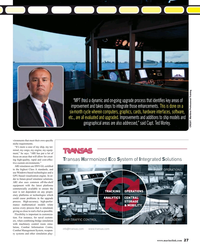
uses simulation technology provided by Transas, another industry giant. The reasons for this business relationship are no less compelling. Captain Ted Morley, Master Mariner and Chief Operations officer of MPT, in February explained why. “MPT selected Transas back in 2002 when we built the first privately-owned
-
 )
November 2021 - Maritime Reporter and Engineering News page: 2nd Cover
)
November 2021 - Maritime Reporter and Engineering News page: 2nd Coverus maritime moran towing ny shipping holding professional corporation association training anthony j. kuczinski, ted tregurtha john j. nardi capt ted morley cpa, cpcu president & ceo president coo president & ceo the coast guard foundation is a vital partner to the coast guard. we support members
-
 )
July 2020 - Marine News page: 27
)
July 2020 - Marine News page: 27hands-on learning and assessments but we are the coronavirus outbreak. Once the pandemic hit, Crowley was all learning and adapting,” notes Captain Ted Morley, COO able to work with many of its vendors who traditionally only and academic principal at Maritime Professional Training offered in-person classroom
-
 )
May 2020 - Maritime Reporter and Engineering News page: 16
)
May 2020 - Maritime Reporter and Engineering News page: 16Training Profles in Training Capt. Ted Morley COO & Academic Principal, Maritime Professional Training aptain Ted Morley is a ubiquitous fgure in maritime training circles, the COO and Academic Principal at MPT in Fort Lau- derdales. MPT consistently enrolls more C than 10,000 students annually, catering
-
 )
May 2020 - Maritime Reporter and Engineering News page: 2
)
May 2020 - Maritime Reporter and Engineering News page: 2Building navy ship out of titanium may not be as far-fetched as is 16 Profiles in Training might seem at first glance. Run the numbers. Capt. Ted Morley, MPT By Rik van Hemmen 18 Profiles in Training Martyn Thomas, SMT 28 Fast-Track Future Classification 24 Software Solutions What will COVID-19
-
 )
March 2019 - Maritime Reporter and Engineering News page: 47
)
March 2019 - Maritime Reporter and Engineering News page: 47S SIMULATION: TRAINING & EDUCATION 1-on-1 with Captain Ted Morley All Images Courtesy MPT “Z-drive training is still a larger driver as more and more new tugs are coming online. Additionally, liquid cargo simulations are becoming increasingly important in the industry.” Captain Ted Morley, COO, Academi
-
 )
April 2018 - Maritime Reporter and Engineering News page: 8
)
April 2018 - Maritime Reporter and Engineering News page: 8replace that of? cer in charge with a fully autonomous ship … that’s pretty scary. I’ve been on ships that have been hit by lightning and you Capt Ted Morley MRIN, AFNI get power surges and outages, and then it comes to USCG Master Unlimited bringing out a sextant to ? gure out where you are in COO/Academic
-
 )
March 2018 - Maritime Reporter and Engineering News page: 57
)
March 2018 - Maritime Reporter and Engineering News page: 57provid- the maritime training tool belt which between the bridge and traf? c control- exception, particularly painful as many ers alike,” said Captain Ted Morley, helps to develop a mariner who comes lers is often where problems can occur, had recently expanded to help fuel a Chief Operations Of? cer
-
 )
June 2017 - Maritime Reporter and Engineering News page: 53
)
June 2017 - Maritime Reporter and Engineering News page: 53anymore. All of the new ships have an amazing amount of modern equipment, and just another rea- son why simulation centers have to step up.” Captain Ted Morley Maritime Professional Training (MPT) Morley. “My father was great at creat- ements, the color palette, the 3D glass ation,” said Captain Morley
-
 )
June 2017 - Maritime Reporter and Engineering News page: 52
)
June 2017 - Maritime Reporter and Engineering News page: 52real Step into MPT’s new state-of-the-art center in Fort Lauderdale is a source of pride for world. S.M.A.R.T. simulation center in Fort Lau- Captain Ted Morley. Five years in the planning, “One of the biggest complements we can get is two years in the construction, the 25,000 sq. ft. when (a customer)
-
 )
June 2017 - Maritime Reporter and Engineering News page: 4
)
June 2017 - Maritime Reporter and Engineering News page: 460 52 56 Training & Education Rolls-Royce & Editorial 6 Authors 8 Where Training is Personal Future Tech Reality MarineLink.com 10 MPT’s Captain Ted Morley put heart & Member Mikael Mäkinen has Rolls- Government Update 12 soul into the new S.M.A.R.T. Center. Royce hurtling toward the fu- On Point with
-
 )
March 2017 - Maritime Reporter and Engineering News page: 58
)
March 2017 - Maritime Reporter and Engineering News page: 58simulation MARITIME PROFESSIONAL TRAINING 1915 S Andrews Ave., Ft Lauderdale Fl 33316 USA Tel: (954) 525-1014 Web: www.mptusa.com COO: Captain Ted Morley All Photos: MPT n South Florida sits MPT, one of the Class A ERS for diesel, steam turbine, most proli? c and progressive mari- and gas turbine
-
 )
March 2016 - Maritime Reporter and Engineering News page: 31
)
March 2016 - Maritime Reporter and Engineering News page: 31of the assessor is removed. For instance, Captain Ted Morley, Chief Operations if a student should have turned a particu- Of? cer. lar valve and didn’t, the computer would MPT’s S.M.A.R.T. campus was devel- record that. “We also use CCTV cameras oped to be a totally integrated simulation to see how
-
 )
March 2016 - Maritime Reporter and Engineering News page: 27
)
March 2016 - Maritime Reporter and Engineering News page: 27, software, etc., are all evaluated and upgraded. Improvements and additions to ship models and geographical areas are also addressed,” said Capt. Ted Morley. CREDIT: Maritime Professional Training vironments that meet their own speci? c niche requirements. “It’s more a case of my ship, my ter- minal
-
 )
Q1 2016 - Maritime Logistics Professional page: 60
)
Q1 2016 - Maritime Logistics Professional page: 60& TRAINING CENTERS Date founded: 1982 Maritime Professional Training Website: www.mptusa.com 1915 S. Andrews Avenue Chief Operations Of? cer: Capt. Ted Morley Fort Lauderdale, FL 33316 Annual Throughput: 12,000+ students Focus of Training: All license levels from 6-pack to Unlim- eration training; engine
-
 )
Q1 2016 - Maritime Logistics Professional page: 35
)
Q1 2016 - Maritime Logistics Professional page: 35Captain Ted Morley, MPT Chief Operations Of? cer Credit: MPT the skills but the job itself. This effort has led to several innovative approaches that “THESIS is the connected com- have become standard ‘best practices’ munity of the ship, shore of? ce, within many of our client companies.” the ship
-
 )
Q1 2016 - Maritime Logistics Professional page: 33
)
Q1 2016 - Maritime Logistics Professional page: 33reasons for this busi- academy. Simulators and content would ness relationship are no less compelling. be connected – for sharing data and en- Captain Ted Morley, Master Mariner abling decisions to be tested, but also and Chief Operations of? cer of MPT, in connected to enable schools to share February
-
 )
October 2015 - Maritime Reporter and Engineering News page: 30
)
October 2015 - Maritime Reporter and Engineering News page: 30. The methods and techniques that were taught when I ? rst entered the industry seem almost prehistoric when compared to what is available today.” Capt. Ted Morley, Chief Operations Of? cer, Maritime Professional Training (MPT) vanced Fire, Refresher and Renewal courses a year.” marina and boat ? res
-
 )
October 2015 - Maritime Reporter and Engineering News page: 28
)
October 2015 - Maritime Reporter and Engineering News page: 28systems can be dangerous Academy and uses that facility to run and create a sense of false security,” more than 60 Fire Fighting classes a said Capt. Ted Morley, Master Unlim- year, including STCW Basic Fire, Ad- Practice makes Perfect: While there is no perfect in ? re? ghting, continuous training in a controlled
-
 )
March 2015 - Maritime Reporter and Engineering News page: 34
)
March 2015 - Maritime Reporter and Engineering News page: 34SIMULATION TRAINING The New RealityThe New Reality Investment in Maritime Simulation Surges “Simulation technology has continued said Capt. Ted Morley, Chief Opera- to deliver as real of a feel as a mariner The proliferation of in- on a more or less steadily upward trajec- tions Of? cer of Maritime
-
 )
July 2014 - Maritime Reporter and Engineering News page: 8
)
July 2014 - Maritime Reporter and Engineering News page: 8to navigate safely. At the bottom of U.S. charts there is a warn- ing: Mariner should not to rely solely on any one means of navigation.” Captain Ted Morley, COO, MPT, agreed: “ECDIS, ARPA, AIS, for exam- ple have all greatly enhanced the amount of information that a watch stander has, but they
-
 )
May 2014 - Maritime Reporter and Engineering News page: 27
)
May 2014 - Maritime Reporter and Engineering News page: 27that new mariners re- member that the new technology does not replace the skills that should be in- herent to every mariner,” said Captain Ted Morley, COO, MPT. “The ability of a deck offi cer to navigate and plot a course is not replaced by the ability of an ECDIS unit. It is also important
-
 )
May 2014 - Maritime Reporter and Engineering News page: 26
)
May 2014 - Maritime Reporter and Engineering News page: 26? Resting perhaps?” “Human error seems to be the catch phrase used when no other explanation is immediately forthcoming,” said Cap- tain Ted Morley, COO, MPT. “While it is true that it is very often the underlying cause of an accident, it is important to put it into context and determine
-
 )
Q3 2013 - Maritime Logistics Professional page: 49
)
Q3 2013 - Maritime Logistics Professional page: 49tion, but we do it because of our desire to maintain MPT equipment with the ?lat-est and greatest? in new developments.? Ted Morley expanded on the value of the upgrades and the MPT relationship with Transas. ?Transas has been a key partner in working towards improving the level of realism in simulation
-
 )
Q3 2013 - Maritime Logistics Professional page: 48
)
Q3 2013 - Maritime Logistics Professional page: 48demand as more companies see the beneÞ ts of that concept. More and more segments are looking at changing their pro- cedures to match that paradigm. Ted Morley, MPTÕs Chief Operations OfÞ cerManufacturerTraining Schools Simulators must Þ t in smaller spaces Raise funds (for upgrades)Simulators must have